The Better Part

Sixteenth Sunday Scripture Readings
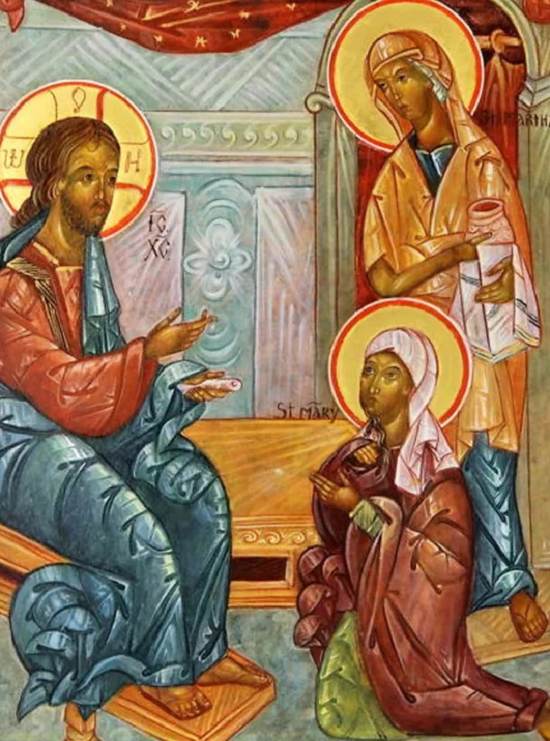
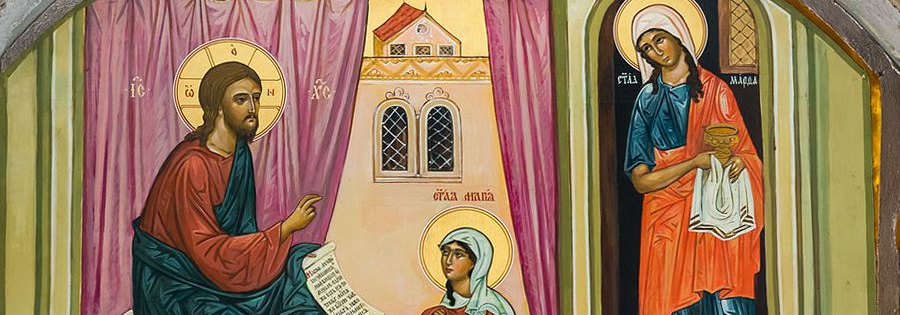
How often have we heard commentators on today’s gospel reading contrasting the roles of Martha and Mary in terms of the active versus the contemplative spiritual life? This suggests that Martha represents an active spirituality, engaging with humankind on its own turf and playing by its rules of engagement—bringing God to the world—whereas Mary represents the contemplative life of withdrawal from direct, active engagement with the world in order to focus one’s attention more exclusively on their relationship with God—bringing the world to God. They told us that some are called primarily to be Marthas, while others are gifted with the grace to be Marys. Yet, for most of us, to live a healthy spiritual life, we need both—to engage with the world as channels of God’s love and service, as well as to withdraw into intimacy with God so that we can be recharged and refreshed. To all of this, I say, Amen!
Today, I’d like to draw some other insights from this gospel reading, contrasting the different roles of the two women, and look at Mary’s “better part.” Martha’s role is easy. We get it. We’ve been there. It’s all about bringing God’s love to the world in the same way Saint Paul did through his preaching and teaching, founding new communities of believers, and expressing through his efforts the healing power of God—physical, mental, emotional, and spiritual. Jesus suffered to bring that reality of God’s love to the world. All that was lacking in Christ’s suffering was our part in it. Paul’s ministry expanded Jesus’s work, as does ours. It’s not two works, but one in the Spirit: continuing Christ’s mission to the world through our work, our “suffering.” It’s clearly a work: doing something to further the reign of God. It’s like as we saw in last week’s gospel where the lawyer asked Jesus, “What must I do to inherit eternal life? As disciples, we naturally see our role, as Martha’s role was, and as Paul’s role was, as service.
Mary’s role is more complex and harder to wrap our heads around. Why? We want to know what Mary was doing. We see her sitting near Jesus—the gospel says she was beside him—at his feet. She was there to receive Jesus, to listen not only with her ears but with her heart. How is it that we listen? I think there are three different listening postures that I’ve experienced. The first is distracted listening. I think that most of our listening is done from this posture. It’s when we’re focusing on something while someone else is speaking, as though it’s going on in the background. It doesn’t have our full attention, but we’re picking up the content, nonetheless. I suppose that this is what Martha was about: taking care of the important things, while Jesus was holding forth.
I’ve been caught in this. My fifth-grade teacher complained to my parents about me during one parent-teacher conference a long time ago. He said that I made him so mad. He was teaching a lesson that he thought was important, and there I was, sitting in front of him, staring out the window. He decided to teach me a lesson and called on me, asking a pointed question about what he had just said. I came to and answered his question perfectly. I was in distracted listening mode.
My teacher would have been less dissatisfied with me had I chosen a different posture, that of attentive listening. That posture has us sitting on the edge of our seats, straining to catch every word and phrase for fear that we might miss something important. In the Eastern Liturgy of Saint John Chrysostom, at various significant points, the deacon cries out, “Wisdom! Be attentive!” We need that, since our minds tend to wander. Psychologists tell us that our attention span lasts only about thirteen seconds at a time before we’re distracted, and we need to be brought back.
There’s yet another listening posture, more profound than either of the others. I call it immersive listening. That’s the kind of experience we have when we’re engrossed in a book or movie. It’s when we lose track of time and, not only that, we lose track of ourselves. The listening part of ourselves, be it with our ears or our eyes, becomes transparent, and we become part of the experience as it draws us along. The subject-object dichotomy is, for a while at least, dissolved.
We already know what kind of listening Martha was doing, since she was obviously distracted. But what about Mary? Was she merely being attentive to Jesus, or had she become immersed in his presence? Because Jesus said out loud that Mary had chosen “the better part,” I would surmise that Mary had allowed herself to lose herself in Jesus’s presence, a sort of foretaste of the Beatific Vision. For most people, this may be the hardest posture to take. It offers the least tangible results and, especially in our contemporary culture, results are what it’s all about.
Have you ever heard someone complain about prayer or, more particularly, meditation? They say, “I don’t get anything out of it because I get so distracted. I can’t focus.” I’ll go so far as to say that we’ll never get anything out of immersive prayer and meditation as long as we’re being results-oriented. There is no immediate return on investment—no ROI. In distracted prayer, at least, like Martha, we’re getting something else done. Or, in attentive prayer, we’re focusing on learning something, or communicating a need, or giving thanks. But immersive prayer and meditation feel, for all the world, like a struggle to stay focused with no reward at the end.
Mary’s prayer—immersive prayer, or listening prayer—is an exercise in pure will power. We will ourselves to be present. We will to remain immersed in the moment because it’s only there that we can find God. We won’t find God in the past, and we won’t find God in the future because neither of those exists in reality. The past is a chimera of our memory, the future is a figment of our imagination. God exists in the now. Immersive, listening prayer is our determination to stay in the present moment. It’s not in the words of our prayers, nor in the vivid pictures that are painted for us, like in the mysteries of the rosary, or in guided meditation. It’s not even in our struggle to silence distractions. It’s only in our willingness to remain still and wait.
That kind of prayer is immensely powerful. Consider this: God has given us everything we have and everything we are. It’s all a gift from God. What, then, do we have to give back to God that hasn’t already been given to us? What is our thanksgiving…our eucharist? The only thing that is exclusively our own to offer God in gratitude is our will to be present to him and to immerse ourselves in him out of love, as Mary did, expecting nothing in return. Indeed…Mary has chosen the better part…and so can we.
Get articles from H. Les Brown delivered to your email inbox