Condemnation or Consolation?

Twenty-Sixth Sunday Scripture Readings
Once again today, we’ve been presented with a very familiar parable. Sometimes, though, familiarity with a text can do us a disservice. This is one of those times. The parable of the rich man and Lazarus is addressed to the Pharisees, who considered themselves to be a superior class of Israelite. They were most often generously endowed with wealth, power, and prestige. Yet, although the passage begins by addressing the wealthy Pharisees, I think it contains an equally important message for the poor bystanders who also heard it.
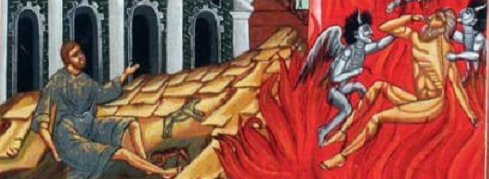
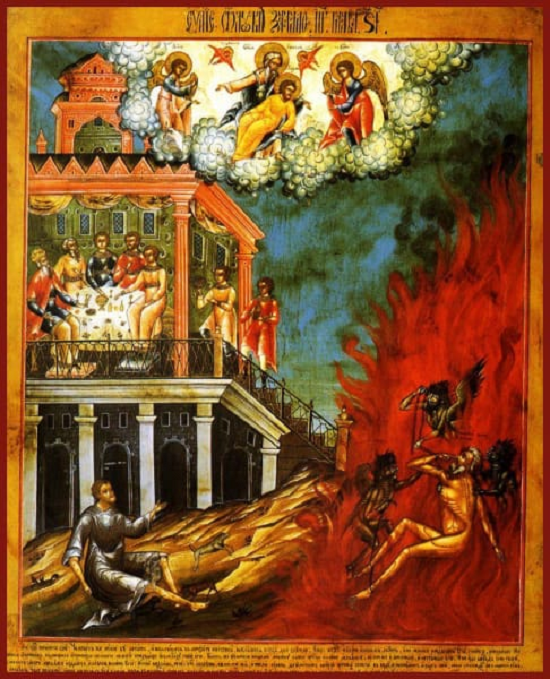
We’re shown a wealthy man, dressed in rich clothing and enjoying fine dining. Lying just outside his door, we find a poor man, lacking the basic necessities of life: food and healthcare. Jesus tells us that both of them died. While the poor man was carried away by angels to “the bosom of Abraham,” the rich man went down into the dirt, the abode of the dead that the Jewish people called Sheol. We might think, as so many have before us, that this is a parable about heaven and hell. We’d be mistaken. “The bosom of Abraham” refers to the patriarch who was the father of the People of Israel and therefore evokes the image of returning to the family homestead. In other words, the poor man, whom the gospel calls Lazarus, was taken home.
The rich man, however, returns to the earth. Most Hebrew texts describe Sheol as a place of darkness, stillness, and separation from God where both the righteous and wicked dwell after death, devoid of light and memories. That description evokes a sense of loneliness and isolation, the plight of a soul in exile. So, what can we say about the “flames” that the rich man complains about as he suffers in torment? Perhaps we can attribute those to the rich man’s reaction to his awakening to the nature of his plight. Death intervened in his comfortable life and opened his eyes to his true condition. Nothing can separate a person from the wealth, power, and prestige they rely on and enjoy more completely than death. Stripped of those externals around which he had built his world, the rich man discovered in himself a poverty more extreme than what the poor man had experienced. He found in himself a poverty of spirit without connection to God or others—a poverty he was unable to alleviate. It was too late. And, in a gesture of ultimate irony, he called out to the poor man to do for him what he had been too preoccupied to do himself when he could have.
The parable speaks of a “great chasm” that prevents people from passing from comfort to torment, or torment to comfort. What could that unbridgeable chasm be but the stubbornness of the human will that no power in heaven or earth—not even the power of God—can change? As the modern proverb states, there are none so blind as those who will not see. Jesus is using this parable, at least in part, to confront those who live in willful ignorance of the poverty and need at their doorstep. He confronts deliberate negligence on the part of those who could do something. The rich man was tormented by what he could have done, but didn’t, and the uselessness of his prayer to accomplish the impossible, that is, to change others’ minds.
Again, this is not about heaven and hell. It makes no sense to imagine that the rich man went to hell for being rich and the poor man went to heaven for being poor. Nowhere in the story are we told that the rich man was evil, nor, for that matter, that the poor man was especially good. The rich man is, indeed, tormented, but not by any external flames. His torment was that of a conscience forever aware of the fact that he was negligent in his obligation to provide for those less fortunate than he, particularly his neighbor…the man lying just outside his door. So, in no way does this parable condemn wealth, power, and prestige, per se. Instead, it condemns the willful neglect of the obligations these things impose on those who enjoy them—the obligation that comes with them to use them to assist those whom we are capable of helping.
This brings us to the flip side of this parable…an aspect that’s too often neglected: the consolation of the poor man. The parable is at least partially addressed to Jesus’s followers, both in Israel before his resurrection and in the Church afterward. Recall how people’s initial contact with Jesus elicited excitement at having found the Messiah, the savior. His first disciples ran around telling everyone they knew. At first, they felt their faith validated by the crowds that followed him. Only later did they feel challenged by those who turned away and finally abandoned Jesus at his passion. It was likewise with the early Church. After an enthusiastic start, over time, and faced with opposition and persecution, the wind went out of their sails. His followers were people looking for support and consolation. They were, like Lazarus, people in need.
In this parable, Jesus doesn’t suggest that the poor man should envy the rich one, nor hate him, nor rise up against him. He never suggested that the poor man would become rich. Alongside his warning to those with great possessions that their deliberate negligence would have consequences, to the needy, he gave the consolation and encouragement that where there’s life and love, there’s hope. Whatever deprivations or trials we may face, we must believe that they’re never permanent. When all was said and done, at long last, the poor man went home.
It’s easy to look at someone else with pity and say to ourselves, “Oh, look at that poor soul,” or to look at someone with anger and say, “Someday they’ll get their due.” But we have to understand that, some days, we’re the rich man, and other days, we’re Lazarus. Christ is risen from the dead so that we might be awakened from the sleep of deliberate negligence of our responsibilities to others. At the same time, we’re consoled by the understanding that the love of God sustains us and, regardless of how bad or difficult things may be, we need not yield to the temptation to despair. For, our home in this life and the next is with God. Nothing but this is forever, and whatever may be our plight, this, too, shall pass.
Get articles from H. Les Brown delivered to your email inbox