But You Do Not Intervene

Twenty-Seventh Sunday Scripture Readings
Among those who most vocally question or deny the existence of God, one of their principal arguments goes like this: “If God is supposed to be all-powerful and wholly good, why doesn’t he do something about all the horrible, useless suffering in the world?” Many of those who ask that question are people who have themselves undergone such suffering and have looked in vain for God to free them from it. Even now, when we look around us, we see incredible suffering. Yet, before we try to address the question of God’s complicity in suffering or our response to it, we should understand that there are two sources of suffering for humankind: the natural world and the human will.
Just last August, there was a serious earthquake in eastern Afghanistan that killed about three thousand people and injured around four thousand others. Couldn’t God have done something to prevent that disaster? I’m sure he could have, theoretically, but why would he? The material universe, by its very nature, operates in a certain way, and the way it operates has made life as we know it possible. The territory of Afghanistan is positioned between two tectonic subduction plates—the Arabian plate to the west and the Indian plate to the east. There’s nothing evil about the movement of these plates. The fact that the Earth’s plates move is part of what makes our planet the miraculous place it is. They’re only doing what they’re supposed to do. That people were injured or died from that movement isn’t the plate’s fault. Neither was it a punishment for them. Hard as it may be to accept, they were where they were when it happened, and their fate was an integral part of that event. As Christians, we’re also assured that death is a necessary part of life—a stage through which all of us must pass at one time or another on our way to the resurrection.
There’s yet another kind of disaster that’s even harder to understand. That’s the suffering inflicted on people by the willful action of others. We witness slaughter and starvation in Gaza, senseless death and destruction in Ukraine, and on our own streets, people being beaten, captured and imprisoned, children ripped away from their families, and innocent people—children and adults—sent without question or recourse to places in the world where they have neither friends nor means of survival. Some ask, “Why doesn’t God intervene and stop this madness?”
How long, O LORD? I cry for help
but you do not listen!
but you do not listen!
Why do you let me see ruin
why must I look at misery?
Destruction and violence are before me;
there is strife, and clamorous discord.
Why doesn’t God intervene? The answer is difficult to hear. God doesn’t intervene because he loves us too much. He gave each of us the greatest and most powerful gift in the entire universe, that is, the gift of free will. Why did God allow humankind the exercise of a free will that he’s unwilling to interfere with? It’s because, without the exercise of our free will, loving would have been impossible. Love is meaningless without the capacity to withhold love. Love isn’t instinctual, nor is it automatic. Love cannot be forced. Love is a free act of the will, or it’s nothing. In effect, God would allow humanity to destroy itself before he would deprive a single soul of the capacity for love. To put it as simply as we can, there’s no human good possible without the possibility of human evil.
Ironically, now we know God’s response to human-caused evil: he allows it out of love and respect for us. So, what should our response to it be? We know well what we want our response to be: we want to stamp it out, to eradicate both it and those who’ve chosen to inflict it on us. Yet even before hearing Christ’s message of unconditional love, we look to the lessons from the past. When has suffering alleviated suffering? When has anger quelled anger? When has violence eliminated violence? When has punishment achieved justice? I’ve used this quote from Gandhi before, and it retains its strength: “An eye for an eye only ends up making the whole world blind.” As the letter to Timothy says clearly in our second reading, “God did not give us a spirit of cowardice, but rather of power and love and self-control.”
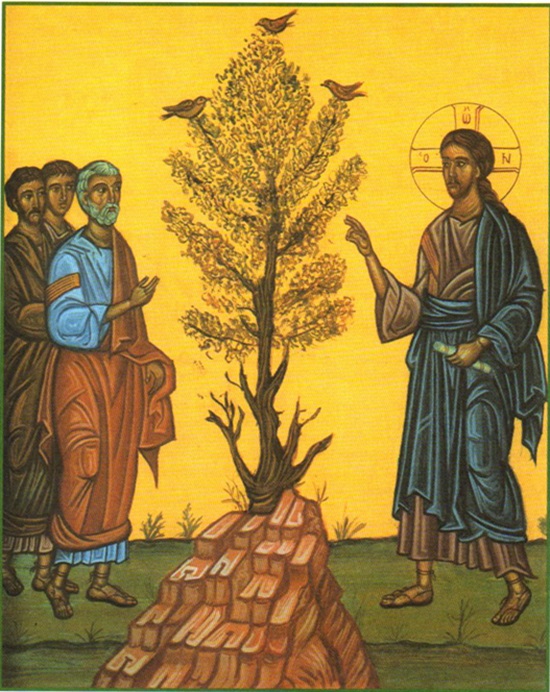
I hope you’ll forgive me if I answer the problem of human suffering by saying, it doesn’t matter what you believe as long as you have faith. However we name or describe our God, it’s only when we begin to trust in God that God makes any sense at all. Beliefs haven’t saved anybody from losing their way or their sense of self. Only faith can do that. Only letting ourselves fall into the arms of the One who might not be there at all gives us the courage not only to endure suffering but to transcend it. Still, we see ourselves as weak. “Lord, increase our faith,” we pray. Only when we hitch our hopes to a hopeless cause and find that, despite all our doubts and fears, we’ve prevailed, do we discover the trustworthiness of God. It’s neither our intelligence nor our strength that allows us to rise above suffering. It’s our perseverance in trusting God despite all the evidence to the contrary that saves us. That’s the essence of faith, the size of a mustard seed: it’s saying yes to God when everything inside us wants to say no.
What does the parable in today’s gospel teach us? In modern terms, it tells us that expectations are premeditated resentments. Our faith—our trust in God—can’t be grounded in the expectation of a given outcome. The servant in the parable would have been foolish to think they should be rewarded with rest, relaxation, and praise for doing what needed to be done. That can’t be the reason why they did it. Likewise, the results of our faith can’t be expected to be wealth, power, or prestige, and they certainly can’t be expected to provide us with freedom from suffering or sorrow. Our faith in God doesn’t provide us with an escape from disasters and injustice. Thinking that faith will be the easy way out is an example of the cowardice that the letter to Timothy spoke about. The results of our faith are far more profound than that. Our faith in God provides us with the moral strength to face not only disasters, injustice, and suffering, but also our fears of these things—fears which are sometimes worse than the things themselves—and it carries us through it all, alive and unscathed. Isn’t that what the resurrection means, after all?
In the end, what can our response to suffering be but faith in the God who loves us regardless of the cost, and without expecting any particular outcome or reward. We can rest assured that God is faithful and, whatever the outcome, it will ultimately be for our good. With that hope, we persevere in our trusting service and do what we need to do to get by. And, when we have done all we’ve been expected to do, we can say, “We have done everything in faith and without expectation of reward because that’s what we were obliged to do.”
Get articles from H. Les Brown delivered to your email inbox