
Dispositions toward Prayer

Twenty-Eighth Sunday Scripture Readings
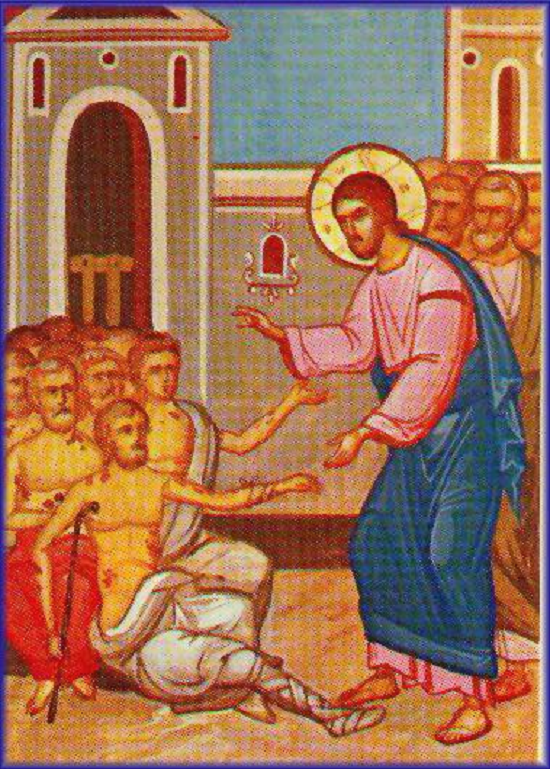
As we’ve plodded along this year through the Gospel of Luke, we’ve had our attention focused on the theme of faith as an unconditional trust in God and God’s boundless goodness and love. The readings chosen for today’s liturgy suggest that, as necessary as that is, it’s not sufficient. Our relationship with God requires not only faith, but also gratitude.
Luke presents to us the need for a triple disposition on the part of any suppliant toward prayer. That is, compunction, perseverance, and gratitude. I think that what’s meant by “compunction” goes well beyond its common meaning of guilty feelings. I think it must be taken in the broadest possible sense, that is, as an acknowledgement of our need. Certainly, we find it in that sense in the parallel leprosy stories from today’s readings. There’s no doubt that both Na’aman, the Syrian general, and the ten lepers on the road were not only conscious of their need for healing but wholly focused on it. All of them sought healing from God through the ministry of God’s instruments: Elisha the Prophet and Jesus. We can see how their compunction—their acknowledgment of need—was accompanied by a strong faith. They trusted that God could and would heal them through these two men.
After compunction, the second disposition we can identify is perseverance. Na’aman traveled a great distance to find Elisha. The ten lepers evidently sought out Jesus because of his reputation as a healer from God. There’s no telling how many dead ends any of them had pursued up until then. The point is that true faith in God demands perseverance, especially in the face of overwhelmingly negative and discouraging signs. Perseverance allows the grace of God space to operate while we supplicants hold our expectations and impatience at bay.
When it at last becomes clear to us that our trust in God and perseverance in prayer has come through—even when that looks nothing like what we expected it to be—the third disposition, gratitude, is in no way optional, regardless of how we define it. We may think of gratitude as “giving thanks,” as though we were returning something back to the one who had gifted us. That’s a peculiar way of looking at “thanks,” though. Thanks are not things that can be given or returned to the giver. Instead, thanksgiving is an attitude. Gratitude, in fact, expresses an awareness of our condition. First, we’re expressing awareness of our neediness. It’s an expression of humility, in that we acknowledge our weakness with sincerity and without pretense. Second, it’s an acknowledgement of our dependence on the love, kindness, and generosity of others. It’s a denial of our stubborn self-sufficiency. Third, it acknowledges our moral and spiritual debt to others, be it God or God’s instruments. It’s a debt that requires repayment, if not to the giver, at least in kind to others or to everyone.
The story of Na’aman is a perfect example of the need for gratitude. The general acknowledged his debt to Elisha. His actions show he was aware that the prophet wasn’t acting on his own, but as an instrument of God. Elisha, in turn, refused to accept payment on that debt for himself as he was only serving God. Unable to repay Elisha, Na’aman instead repaid his debt through his faith in Yahweh and his commitment to worship only him who, after all, had engineered his cure. Likewise, when we’re recipients of God’s healing grace, regardless of the channel through which it comes to us, we have an obligation to repay that debt not only through our service of God, but also by becoming ourselves channels of the grace we’ve been given by offering our service to others. That’s how we are to express true gratitude.
Now, what about the nine who were cured but didn’t return to express their gratitude? Their attitude spoke volumes about them and their character. True, they did exactly as they had been instructed to do and went to show themselves to the priests to receive from them a clean bill of health. Obedience in pursuit of prayer is a very good thing. Even Na’aman at first balked at washing in the Jordan River. He thought it was too easy. But, scolded by his servant, he eventually came around and obeyed the prophet’s instructions. Yet obedience is only an aspect of perseverance and is no substitute for gratitude.
What the nine lepers’ behavior said about their character was also threefold. First, they behaved as entitled people. They lacked humility, even in their destitution, and acted as if healing was something they were owed. Second, it said that they considered themselves self-reliant and blind to their dependence on others, even God. And, finally, in their arrogance, they ignored their indebtedness to the One who had cured them. It was as though they tore up their IOUs to God and to Jesus, the source of their healing. No matter how cured they appeared on the outside, or how self-satisfied they felt on the inside, their behavior revealed them to be arrogant, haughty, and disrespectful both of their gifts and of their benefactors: a disease as bad as leprosy.
One last note. The man who returned was a Samaritan. He was from a tribe of Jews who had intermarried with the Babylonians and whose religious practices didn’t recognize Jerusalem as God’s city or the temple as God’s exclusive home. The man was considered by orthodox Jews to be both a half-breed and a heretic. Yet, he was the one who came back. We could take away from this that no one is too lowly or despised to be a recipient of God’s love and grace. Outward conversion is not a requirement for God’s love and mercy. The only thing that matters is metanoia: that conversion of mind and heart that Jesus constantly preached. What is that conversion? It’s that tiny step from arrogance, entitlement, and self-reliance to humility, reliance on God, and the willing repayment of our debts of gratitude through our loving service of God and our fellow humans—all of whom, without distinction, are our neighbors.
In short, gratitude isn’t optional, and it’s not giving back to God as a kind of quid pro quo on our part. It’s, rather, a reflection of who we are and how we see ourselves. It’s a humble acceptance of our dependence on God and our need to return his love with love. Gratitude is that which both defines and expresses who we truly are.
Get articles from H. Les Brown delivered to your email inbox