The Advent of Mindfulness

First Sunday of Advent Scripture Readings
The way this morning’s gospel reading opens is particularly interesting when you consider the scene. We know how the Book of Genesis presents the story of Noah and the flood—God has become disgusted with the evil that humans have gotten themselves into, so he decides to wipe the slate clean and start over, taking just a handful of the innocent into the ark to save them from the devastation to come. The hordes of evildoers are destroyed, while the faithful remnant is preserved safe to start over. Yet, when Jesus tells the story, the whole emphasis shifts.
In Jesus’s teaching, the whole question of good and evil is gone… vanished. Did you notice? The people in this version of the story are just going about their daily routines: eating and drinking, marrying and giving in marriage. And not just daily routines; they’re engaged in activities that sustain the life of the human species. What’s so wrong with that? Nothing, on the surface… or so it seems. And yet, Jesus makes an example of them. They were carried away by the flood not because they were doing evil, but because they weren’t paying attention. They never saw it coming.
And there it is: the word that characterizes this whole liturgical season: coming. That is, after all, what Advent means. Veni, “I come.” Ad-veni, “I come toward” or “I approach.” Jesus addresses his comments this morning to his disciples—that is, us. He warns them to pay attention, because the Son of Man who comes into our lives from the reign of God, is approaching with a judgment of justice. He doesn’t want them to get so caught up in the affairs and concerns of the day that they miss their opportunity to be a part of it, and become like the people caught in the flood because they weren’t paying attention.
Every year at this time, preachers comment on the three comings of Christ. They talk about how the Israelites, through their prophets and priests, longed for the coming of an anointed king—a Messiah—to rescue them again as God once rescued them from the Egyptians. They talk about the coming of the savior-Messiah from God, born from and into humanity, to save us not only from slavery and oppression but from the frustration of living life in futility and alienation from one another and from God. And, of course, they talk about the coming of the Christ at the end of time with justice to gather the faithful together into the reign of God in eternal life.
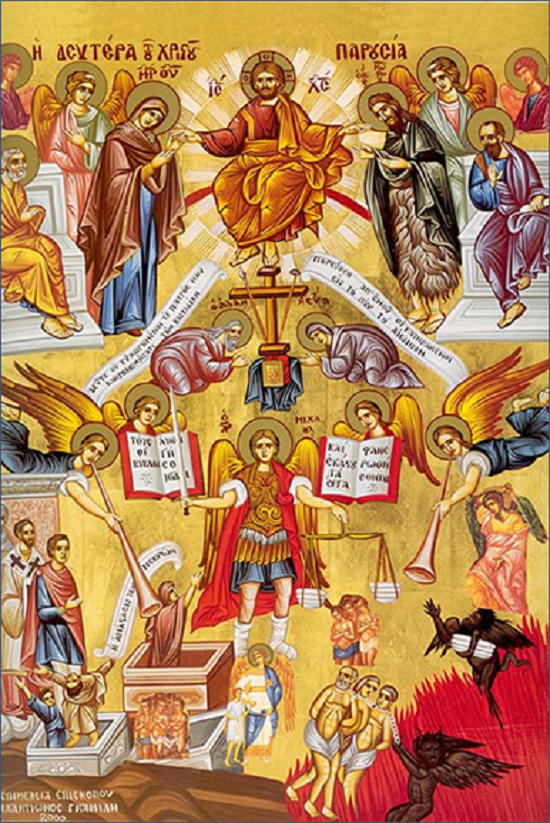
We can find suggestions of all this in today’s gospel. It cautions us not to mistake the so-called “Last Judgment” for something in the far-distant future, because the three comings of Christ are confined neither to the past nor to the future. If they were, they’d have nothing to say to us. But we, too, groan under the weight of the futility, isolation, and meaninglessness that haunt our human existence like dark and menacing shadows. We observe the anger, hatred, ignorance, and cruelty that infest our world, and wonder if it ever gets any better, because we’re well aware that it could get much, much worse. Still, we trust that Christ, born once and risen from the dead, is even now God-with-us—Immanuel—and yet we struggle to find him where we’ve been told his presence dwells: in the Church, in the Sacraments, in the Scriptures, and in one another. What does it feel like when those religious institutions we rely in to be our icons, the images of our God, fail to reflect him? And what about the coming of the Son of Man? When will he ever come? Does it even matter anymore?
Surely, descent into discouragement and despair is the price we pay when we become distracted by all the seemingly “important” things of life that demand our attention. These are the same energy syncs we’ll look back on at the end of life and wonder why they ever mattered. When we’re immersed in the busy-ness of life, it’s way too easy to lose focus and ignore those deeper, less urgent, but more important aspects of life, namely, our spiritual connections to one another and to God. We become too easily untethered from the anchor of our awareness of God and drift aimlessly in a sea of banality. We lose touch with God’s Advent, God’s coming toward us, not in the past nor the future, but now. Our longing for meaningful connection is happening now. The coming of the Son of Man with judgment on our striving, our victories, our failures, and our redemption is right here and now.
From this perspective, Advent presents one of the simplest tasks we’ll ever undertake, and it’s also one of the most difficult. That task is our call as Christian women and men to mindfulness. Though we continually want to rest, to let ourselves be overtaken by the countless details of daily life that demand our attention, Advent just won’t let us slack off. The call we receive today from our liturgy and our Scriptures is the call to pay attention and to allow the distractions of daily life to become transparent once again to the love and care of God—a love and care that always lies just beneath the surface. Inertia and oblivion only encompass those who ignore the miracles of grace that surround us. It can be different if only we would open the eyes of our minds and hearts to see. That’s the metanoia that Advent is calling us to. “So too, you also must [awaken], for at an hour you do not expect—that is, right here and now—the Son of Man comes.”
Get articles from H. Les Brown delivered to your email inbox