Two Kinds of Death

Christ the King Scripture Readings
This past week, Craig and I watched two unsettling films. One was The American Revolution, a six-part PBS series by Ken Burns, and the other was Nuremberg, now in theaters. Although they covered different topics and came from different eras, both dealt with death, and both left me reflecting on it in similar ways. While watching The American Revolution, the depiction of thousands of men marching in straight lines, firing muskets at each other, made me pause. People in the eighteenth century must have had a very different relationship with death than we do now. We know that every military action throughout history has involved soldiers stepping over the dead and wounded to move forward. They say they become desensitized to it. But facing a barrage of musket balls at close range is an entirely different story. What kind of mentality drives someone willingly to face probable death like that? What must they have been thinking? “I’m probably going to die… oh, well, I’ll take another step forward anyway”?
The other film, Nuremberg, was a dramatization of the 1945 Nuremberg trials of twenty-two leading Nazi officials. The film was based on source documents and eyewitness accounts. During the trial, the prosecution showed a documentary film to everyone present, taken during the liberation of the concentration camps. It was the first time anyone in that room had seen the results of that slaughter. The movie showed portions of the actual 52-minute film shown during the trial. Much of it was worse than anything I’d ever seen before. For those tasked with cleaning up the camps, death surrounded them on such a massive scale that it obviously became impossible for them to view the heaps of corpses as individuals with identities and lives. Yet, each of them had been born, grew up, suffered, and died.
Didn’t those same attitudes have a role to play in the death of Jesus on the cross? The routine of the executions, the production and disposal of corpses, the dehumanization of the victims all had a role to play then as they do now. So, from that time to this, what has the Christian community been trying to tell us when they point to Jesus as the “King”? Look at the historical context, first of all. For centuries, the people of Israel had been hungry for a savior-king, the anointed of Yahweh, the Messiah. Even Jesus’s name in Hebrew, Yehoshua‘, was derived from יֽהוּא שׁוּעַ (yehu’ šua‘), “he is savior.” What was the messianic king and savior doing dying on a cross? That was the question that scandalized the people of Israel, and it’s still the question we must ask today.
Jesus taught the world an important lesson through his death and resurrection: that there are actually two kinds of death. One is physical and as natural as birth. It comes to everyone. No one gets out of this life alive. We can’t argue with it or bargain it away. It can’t be bribed or avoided. We know that those women and men whom Jesus raised from the dead only had to die again. There’s an inevitability and randomness to physical death. Even the Son of God, who brought others back from the dead, surrendered himself to it. His passage through death revealed to us what comes after: the resurrection. The point of Jesus’s ministry that is repeated in all the gospels was not to avoid the death of the body, but by surrendering to it, to emerge from it transformed.
Yes, but there is another kind of death far subtler and more insidious than the physical. That’s spiritual death. Unlike physical death, spiritual death isn’t inevitable and isn’t irreversible. It’s voluntary. Spiritual death is marked by the loss of compassion, care, and concern. It happens when people go into battle with everybody and everything—even with God—in order to get their own way. It occurs as people come to ignore the damage their thoughts, words, and deeds cause to others. It doesn’t matter to them whether the injured are their intended targets or just “collateral damage.” Unless there’s a metanoia, a change of heart, spiritual death is absolute and devastating, even though it doesn’t feel that way at the time. As long as spiritual death remains a chosen way of life, there can be no resurrection. “I see dead people. They don’t know that they’re dead.” Yet, like the soldiers who crucified Jesus and the bystanders who gawked at him, for their victims, they represent nothing but random instruments of the physical death that’s part and parcel of creation as it is. As a doctor once told our family, as my father lay dying, “Well, you have to die of something.”
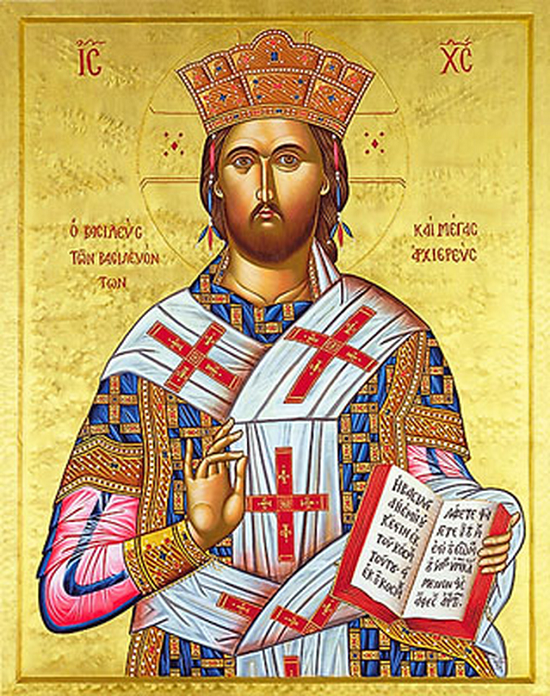
Today’s gospel passage reveals Jesus as king—the victor and master—over death. He was surrounded by those who expected him to fight and to refuse to cooperate with those whose spiritual corruption had led to his being nailed to the cross. But his mastery and kingship weren’t exercised over the inevitability of physical death. Not even Jesus saw any purpose in denying that reality that comes to us all. No, Jesus conquered spiritual death by refusing to try to escape death by his own wisdom and power, choosing instead to put an end to the damage and destruction that spiritual death causes to those around it.
We are mistaken if we see physical death as evil. It’s simply part of the natural order of things. It’s spiritual death—the lack of care and concern for others—that’s the real evil in the world. Evil isn’t a thing, and of itself it has no power. It’s a lack of something that should be there. As such, spiritual death lacks the basic virtues that empower life. Those virtues are faith, hope, and love. We proclaim that Jesus, the Christ, the image of God in the world, conquered sin and death. He conquered physical death by surrendering to it. He conquered sin—that is, spiritual death—by refusing to give in to the temptation to control the outcome to suit himself.
When we survey all the storms raging around us today, what we’re seeing are the forces of spiritual death taking out their anger and frustration on those for whom they care little or nothing. We see people and structures surrounding us that are in the throes of spiritual death. We have a choice. We can rise up and fight against them, and so become just like them, or we can follow the lead of Jesus, our King and pioneer, and yield our trust over completely to the God who has the power we lack… the power to take us safely through the gates of physical death and, like Jesus, to be raised up with him. Does that mean that, when we find ourselves surrounded by the forces of spiritual death, we just give up? Did Jesus give up? No, rather than trust in our own goodness, virtue, and strength, today, we rise up and stand up to whatever comes with unshakable faith in the One with the power to sustain us through it all, even through death itself. “Amen, I say to you, this day you will be with me in paradise.”
Get articles from H. Les Brown delivered to your email inbox