On the Road Again

Third Sunday of Easter Scripture Readings
I can’t overestimate the importance of today’s gospel reading. If you’re looking for an exposé of what the life of a Christian is all about, you won’t do much better than right here. It begins where we all begin—in the midst of disappointment, discouragement, and resignation. We’ve all been there and, in my opinion, without it, you can’t appreciate what it really means to follow Christ. I’d go so far as to say that the cross is the only door to God through Christ, and there is no other.
Think about where the disciples were coming from. The master died an ignominious death, some women were talking nonsense about the empty tomb and seeing him, and the Apostles were paralyzed with indecision. There was nothing left for them in Jerusalem. They didn’t need any more drama. Home was only two hours away. Two hours to walk. Two hours to talk. Two hours to do what we always do: lose ourselves in a post-mortem of failed hopes and plans. What went wrong? What did we miss? It softened the sting of loss.
It wasn’t at the tomb, it wasn’t in the locked room, it wasn’t in Jerusalem, but it was on the road of remorse that their hearts burned. For the Jewish people, the heart was the center of understanding, not feeling. They’d had enough feeling for a while. What does it feel like, after all, when the thick clouds of confusion start to dissipate and we get to see more clearly, bit by bit, the shape and dimensions of a conundrum that’s held us baffled in its grip for a long while? Doesn’t it burn?
The disciples needed to get away from the confusion and chaotic emotions of the city and on the road before any of it could begin to make sense. What happened when they, Scripture scholars that they were, began to look at the all-too-familiar passages of the Law and the Prophets through the lens of the crucifixion? A little distance allowed them to see what they believed from a whole new perspective. What had been so familiar now struck them as if for the first time. It’s sad but true for all of us that it takes a wildfire for us to see the forest for the trees. Was Jesus with them? You betcha… but no less than how he’s with us when we’re walking away.
That companion on the road is always with us, but he never walks shoulder-to-shoulder or speaks unless we’re ready, and unless we’re ready enough to want his presence, and to invite him into our private space. He doesn’t come with us unbidden, and he doesn’t stay with us uninvited. We somehow have to be lost and hurting enough to turn to the last resort. God’s still there when all else fails.
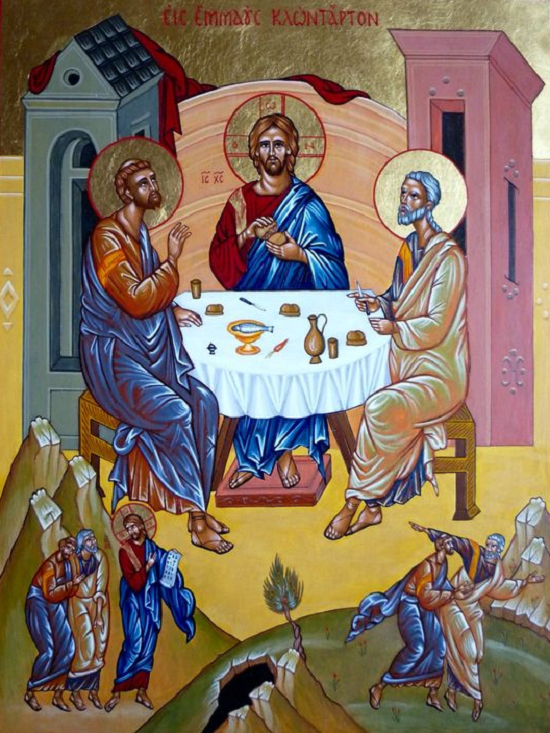
And then, the meal… sharing the staff of life with a stranger. It’s not an accident that recognition comes at the moment of breakage. This is not just a superficial acknowledgment. The Greek word is επιγινώσκω (epiginōskō). That’s a resonance that began with the new understanding of the old Scriptures and deepens until it shakes us to the core. It’s in our thwarted dreams, our shattered plans, our broken lives that we finally recognize the One who was with us the whole way. In the breaking and sharing of the bread, we are nourished. On the road, we understood that it’s not until we share a life taken, blessed, broken, and given that we are transformed into the Real Presence. We are the bread of transubstantiation.
Once transformed, we’re not the same. We’re not satisfied to sit at home moaning, complaining and licking our wounds. Augustine wrote, “You have made us for yourself, O Lord and our heart is restless until it rests in you.” So, we get up from the table and leave our safe, comfy space, and get back on the road. We go back to where we left, but nothing is the same. Our destination’s not the same. We’re not the same. We’ve had a metanoia to the core.
Luke put this story between the empty tomb and the believing Apostles for a reason. It’s not an accident; it’s a lesson. He’s teaching us about the nature of our eucharist. We set out on the road on a Sunday morning like today, with the disappointments and cares of our world weighing us down. We encounter the Scriptures through the lens of our pain, and so our hearts burn within us. We invite our companion to dine with us, and we recognize him—and ourselves—in the bread taken, blessed, broken, and given. And, when all is said and done, we’re sent out to go back where we came from, enlivened, to bring what we have found to others and to be for them the companions on the road that Christ was for us.
We have arrived home to Emmaus. It’s time to invite the stranger who walks with us to break bread.
Get articles from H. Les Brown delivered to your email inbox