Remembering Our Commitment

The Baptism of the Lord Scripture Readings
We celebrate together this morning not only the Baptism of the Lord, but a brand new start to our year of anamnesis—a word that means “remembrance,” but in a unique sense. Anamnesis is the opposite of remembrance as we commonly think of it: a mental return to revisit some past event. Anamnesis is a remembrance that takes those events from the temporal storehouse of the past and brings them forward into the present so that we get to live and experience them once more in real time. If remembrance of God’s presence and actions meant simply recalling them as they were in days long past, they would have no power to affect our lives any more than the Trojan War or the Fall of Rome does. But anamnesis in the Scriptures—particularly in the gospels—and in our liturgies—especially in the Eucharist—creates for us a personal encounter with the living God, Father, Son, and Spirit, and God’s saving power here in the present moment.
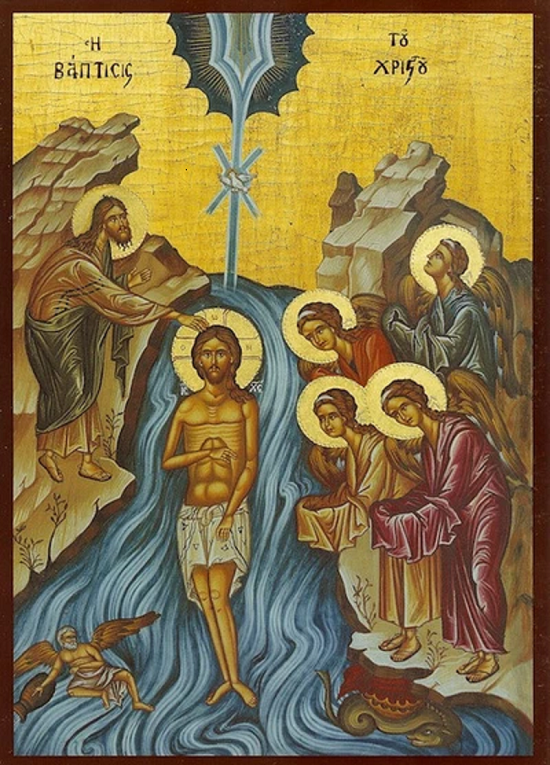
The full manifestation of God’s presence and power to save us from ourselves began here in this Gospel as the anamnesis of when Jesus submitted himself to baptism by John in the River Jordan. Nothing of what we read in the Scriptures—not the Law of Moses, nor the writings of the prophets, nor God’s self-revelation through the history of the people of Israel, nor the Annunciation, nor the Virgin Birth—would have had an impact on our lives without this unique moment in time. This was the kairos—the critical moment—when salvation shifted from promise to fulfilment and from potential to actuality. As we saw during our journey through the Sundays of Advent, the baptism of Jesus was more than just a cleansing from the issues of the past. With John, it became the indication of a metanoia, a change of mind and heart, and a commitment to a new future. Jesus, as the creative Word of God since before the dawn of creation, came as the Christ, the Messiah, the promised savior of humankind. Yet, as the son of Mary, Jesus was fully one of us and heir to God’s greatest and most terrible gift to us: the gift of free will and its capacity to say no.
Without Jesus’s assent to his destiny as the Messiah and the outward manifestation of his metanoia in accepting baptism from John, his mission and the promise it embodied would have remained forever an unfulfilled hope. But Jesus did not say no. His acceptance of his Father’s will, embodied in that moment, determined not only the rest of his life, including his suffering, death, and resurrection, but also what kind of Messiah he was to be. As he came up from the waters of commitment, he experienced the heavens opening to him. The firmament that separated the unseen from the seen, the future from the present, and God from humankind was dissolved. The commitment took flesh in Jesus to accept the will of his Father to be and to become not some hero of this world of wealth, power, and prestige, but the servant sung about by the prophet Isaiah in his songs of the Servant of Yahweh: “Here is my servant whom I uphold, my chosen one with whom I am well pleased, upon whom I have put my spirit.”
Although the Father committed his only Son to become the suffering yet victorious servant of all, it took Jesus’s acceptance of that commitment to make it alive and real. Just so, our families committed us to take on the same role and the same purpose when they presented us to the Christian community for our Baptism. Like Jesus, we have the same opportunities to accept that commitment made for us to become the faithful people that we were created, called, and baptized to be. As for Jesus, so for us, it’s an acceptance that must be made and remade every moment of every day until we come to the same fulfilment that he did. Jesus never faltered, never wavered, never yielded to distractions. The same cannot be said of us, even though we share the same love of the Father for us that Jesus experienced, and have received the same Holy Spirit that Jesus was given.
The Father knows the fidelity of his beloved Son and the weakness of us, his people. Still, we share the same human flesh and blood—the same humanity—and the same Spirit that Jesus had. See the love that the Father has shown us in making us his children and co-heirs of eternal life with his Son. Jesus has enabled us to become one with him and with one another by calling us to share in this gift of himself—his body and blood, his soul and divinity, his mission and his victory—in this Eucharist. Jesus’s acceptance of his baptismal commitment was once forever and for all. Ours must be renewed over and over again, so it is that we need this anamnesis of the Eucharist continually to maintain our spiritual commitment, to stay true to it as Jesus did, and to pick up and go on when we falter or when the road ahead looks too daunting.
Remember that nothing we read about in the gospels concerns Jesus alone. You and I are implicated in every word and action that we read about there. Like Jesus, we have allowed ourselves to accept baptism and the change of mind and heart—the commitment to become faithful servants of God and one another—that it entails. And, like Jesus, with that acceptance, the curtain in the temple, the veil between heaven and earth, between God and us, is torn open. As we, too, say yes to the call of our Father to become our most authentic selves and to be of service to God and one another, we, too, can hear once again our Father say to us, “You are my beloved child in whom I am well pleased.”
Get articles from H. Les Brown delivered to your email inbox