
Give Me a Drink

Third Sunday of Lent Scripture Readings
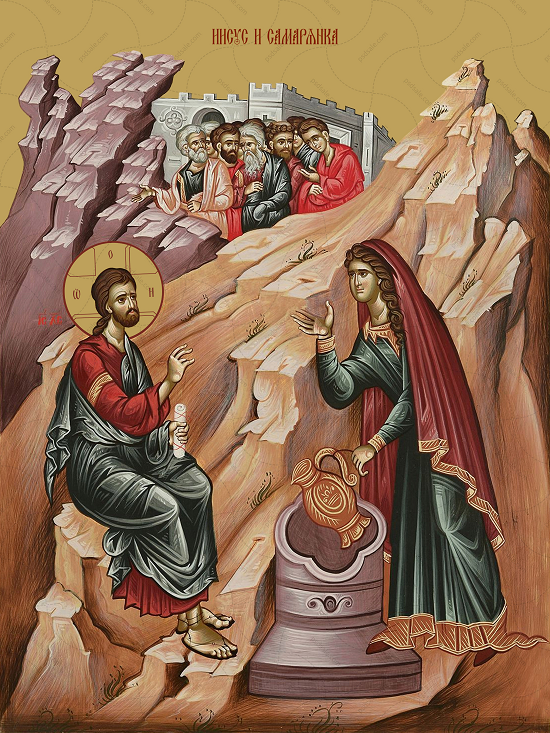
Every reading and every homily for the past five weeks has had but one focus: the identity of Jesus as the icon—the image—of Yahweh, Father, God. This Sunday and the two Sundays to follow only deepen our introspection. First Sunday of Lent, the temptation and victory over doubt and despair; Last Sunday, the transfiguration and the divine shining through humanity; Today, the God who thirsts.
We are walking a subtle but profound path. It’s the path of revelation, the path of metanoia, and the path of commitment. The six weeks of Lent are the final weeks of preparation for the catechumens on their path to the waters of Baptism at the Easter Vigil. Today begins their scrutinies—the weeks of investigation of their faith leading up to their final profession of belief in God, Father, Son, and Spirit, in the baptismal creed.
Revelation: Jesus doesn’t approach the Samaritan woman as a proselytizer. He’s not interested in converting her and making an observant Jew out of this heretic. He’s not approaching as a judge, either. He’s not interested in correcting her beliefs, normalizing her relationships or punishing her for her behavior. He’s not approaching as an enforcer of social mores, questioning and criticizing her being out in public at noon unchaperoned. In fact, he deliberately ignores the criticism of his own disciples who upbraid him, the rabbi, an observant Jewish man, for speaking with a woman and a Samaritan. None of this interested Jesus. He came to her with only one purpose. He was thirsty. God does not come to us with expectations, critiques, or judgments. God comes with needs.
Metanoia: Our response to God’s self-revelation is a change of mind and heart. Catechumens aren’t the only ones going through a transformation. Every one of us started out where we find the Samaritan woman, seeing only the superficial. She sees only a man, and he is “other.” He’s a thirsty man. She’s a woman. He’s a Jew. She’s a Samaritan. He has status. She has none. He’s a prophet. She’s a sinner. He’s the Messiah and savior of the world. She’s suddenly a disciple. The transformation is radical. As she confronts this person in need, their roles shift radically. As she travels inward, she sees herself as the one in need, and he who came to her in need becomes the one to provide her with what she lacked. In that realization, we come to understand who God truly is. He’s the one who, despite Israel’s infidelity at Massah and Meribah, provided them with running water to preserve their lives and who, at the well, provided the woman with running, living water to counter the aridity of her own soul.
Finally, commitment. Once we’ve encountered the God who thirsts, we’re never the same again. Like the woman at the well, once we see the neediness of the world with the eyes of faith, our roles are reversed. We come as needing to listen and learn rather than as problem-solvers. Any hospice chaplain will tell you that the most effective visits don’t begin with ‘I’m here to help you’ but with ‘Tell me about that photograph on your dresser.’ The one who comes needing something creates the space where the real conversation happens. We see our own thirstiness masked by the water we have—the wealth, power, and prestige—that cover and hide it. And we see how providing for others’ needs satisfies our own thirst for meaning and relevance in our lives. When we approach others to tend to their wounds, we find our own wounds exposed—yes—then healed.
That paradigm shift, that shift in perspective, doesn’t come to everyone. Not everyone is approached by the thirsty God and recognizes him. Not everyone is willing to look at their own woundedness and set out on the path to metanoia. But to all of us who do comes the catechumenate and the watershed moment—the baptismal moment—when we die to our own neediness and commit to addressing the neediness of God in the needs of others. It is a boundary-crossing moment when it finally becomes clear to us that we are no longer different but the same. In fact, we always were.
Like most cultures of the past, our contemporary culture thrives on the fallacy of “us” and “them.” It needs enemies to bolster its self-image. It needs those it can feel better than. It needs someone or something to fight against, to hate, to vanquish, to conquer, to win over. That world is a zero-sum game where, in order for me to win, somebody has to lose to the point that, in order for me to live, somebody has to die. What today’s Gospel and, indeed, all of Lent, tells us is that we worship a thirsty God who comes to us looking for what we have to offer—namely, our brokenness. What God offers us is not to “fix” us but an opportunity in the service of others to discover that our own thirst—a thirst we might not even have been aware of—is slaked with running water, the living water of God’s Holy Spirit himself.
Get articles from H. Les Brown delivered to your email inbox