The Nature of Sin

Fourth Sunday of Lent Scripture Readings
You know, it’s not every Sunday that I get significant theological insights and understanding from my work with the scriptures in preparing my homily for you. Today was an exception. Today, while thinking about the gospel and putting the pieces together, I actually said, “Wow!” out loud. I got excited because I put pieces together that I’d never seen that way before and saw an explicit connection I’d never noticed. I can’t wait to tell you about it.
I’d been convinced for many years now that most people completely misunderstand sin. We’ve even classified it as “original sin,” “mortal sin,” “venial sin,” and the unforgivable sin against the Holy Spirit. But putting sin into neat categories doesn’t serve at all to help us understand what it is. In fact, my first Lenten lecture series was on the topic of sin. Yet today’s readings helped me find new insights into this obscure idea. We’re very fortunate this year to be in Cycle A, where the Lenten readings follow the ancient pattern of teaching that leads up to the baptismal death and resurrection at Easter to today where we encounter the one who provides the healing that relieves our spiritual blindness.
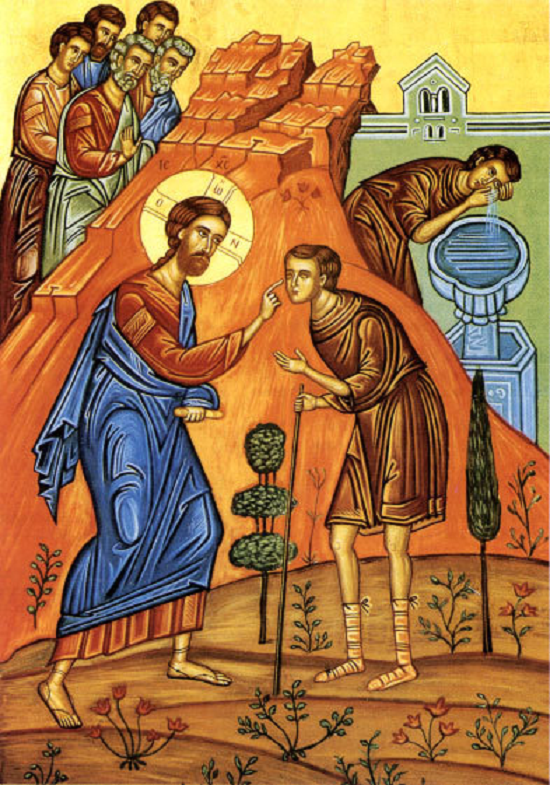
He is the one who “spat on the ground and made clay with the saliva and smeared the clay on [the man’s] eyes.” This was an act of new creation that John spoke about in the prologue of his gospel when he wrote, “What came to be through him was life, and this life was the light of the human race, the light shines in the darkness and the darkness has not overcome it.” [John 1:4-5] Next week, we take the final step in this revelation of Christ’s identity as we see in the raising of Lazarus the light of life in action.
Today we see a double arc: the movement from the darkness and blindness of sin to the light of faith at the same time we witness others with eyes wide open in the presence of the light descending into the darkness and blindness of sin. In truth, humanity has always seemed to be obsessed with sin and punishment, wrongdoing and retribution. Christianity long ago fell into the trap of believing in hell and the “punishment due to sin.” This is because, like the disciples this morning, we want to blame somebody. We want to make somebody responsible and then see that they’re punished for it. Like Gilbert and Sullivan’s Mikado, we want “to make the punishment fit the crime.” When we see an effect, we want to discover the cause. But right off the bat, in his first statement today, Jesus rejects that whole concept. Difficulties in life are not consequences—they are the stuff of life for which God gives us the grace to overcome it. Instead of punishment for wrongdoing, the man’s blindness becomes the opportunity for the healing and creative power of God to reveal itself.
Now, as we go more deeply into this gospel story, we encounter the true nature of grace and the true nature of sin played out, one against the other. The man’s blindness provides the field on which the grace of God is played out. His healing isn’t a static event. It takes place in the course of a baptismal mission. The man is sent to the healing waters of Siloam and he goes. He responds. He has no idea what awaits him at the other end of his mission. Yet he goes. He trusts. Would you? The result of his trust is overcoming his obstacle to a full, rich life.
And what happens when he comes back? His neighbors challenge him. When change—when metanoia happens—happens, the environment resists. Change in one threatens the complacency of others. “Who did this to you?” they ask, looking again for someone to blame. “The man called Jesus.”
They bring him to the Pharisees for whom sin is breaking the rules. They’re in a quandary. Jesus is obviously a sinner. Yet how could a sinner perform a sign of such magnitude? Do they question their own understanding? No. They assume that they’re seeing the facts correctly while those outside their circle—the neighbors, the parents, the man himself—must be lying sinners. Even Jesus must be the sinner, for the man himself, Jesus is a prophet.
And then the parents. When confronted, they don’t want to speculate. They’d rather claim ignorance than risk the consequences of confronting the blindness of the powers that be. It’s a matter of truth and consequences. Speaking the truth to power always has consequences. It’s much easier to feign blindness than to bear witness to the light.
The second confrontation with the Pharisees is the climax of the story. The Pharisees must see Jesus as a sinner; otherwise, their worldview would collapse. As a result, they sink into the morass of crime and punishment, sin and hell where we began with the disciples. The Pharisees need retribution theology, otherwise their whole belief system is called into question. Meanwhile, faced with push-back from his neighbors, the cowardice of his parents, and the violent opposition of the religious and civil authorities, the man himself finds his faith deepened and solidified. He professes Jesus as a man sent from God.
At every Alcoholics Anonymous meeting, the speaker begins with the same formula: “My name is So-and-so, and I’m an alcoholic.” No credentials, no theology, no explanation of how alcoholism works biochemically. Just a confession of experience. And then: “This is what happened to me.” The power of AA is that personal testimony outweighs expert argument. The man born blind is running the oldest AA meeting in history: “I don’t know if he’s a sinner. One thing I do know is that I was blind and now I see.” He doesn’t argue theology with the Pharisees. He tells them what happened, and in the telling, his faith in a power greater than himself, and the faith of anyone open to listen to him, deepens.
I said I had a “wow” experience, and here it is. As the gospel progresses, the man’s understanding of what happened to him and his faith in Jesus and in God deepened. At the same time, as the knowledge and understanding of the event developed in the Pharisees’ experience, their resistance and recalcitrance also grew and deepened and became more intractable. Those are the two arcs of the story—one coming from a misunderstanding of sin to a practical faith in God, the other from a confrontation with an uncomfortable truth to a descent into intractable sin. We’ve gone from the common human misunderstanding of sin to an example in very human terms of the reality of sin grounded in arrogant and deliberate ignorance. That’s the reality of sin.
“Here’s the ‘wow.’ What we call original sin is not a stain inherited from Adam. It is the arrogant and deliberate ignorance into which every human being is born—the blindness that believes it sees. And the movement from that blindness to sight, from that ignorance to faith—that is metanoia. That is the baptismal moment. That is the watershed between death and life.”
Readings & Homily Video
Get articles from H. Les Brown delivered to your email inbox