It Is I

Nineteenth Sunday in Ordinary Time Scripture Readings
What’s it like when we’re facing a difficult situation, and the outcome can go either way when there could be serious consequences? Inside, we go, “Please don’t let this turn out badly.” It’s as if we’re pleading to the anonymous power of fate that determines the outcome of events, asking for what? Aren’t we asking for certainty? Don’t we want the certitude that the painful, damaging consequences we see threatening us will be removed from us? We want to be sure that the outcome of this challenge will be beneficial for everyone—or at least for us.
We may not always recognize that this “hope for the best” is a prayer, but what else could it be? We want—or, more often, we may expect—God to make the difficulties and disasters go away. “Please don’t let my business fail.” “Please don’t let me be laid off.” “Please don’t let me go broke.” “Please don’t let it be cancer.” “Please don’t let her die.” Yet, more often than not, the thing we’ve dreaded does come to pass despite our ardent hopes and prayers. How do we feel then? Disappointment? Anger? Was it my fault that my prayers weren’t heard, or has God just decided to ignore me in this?
Even Saint Paul struggled to understand why the answer to his prayers for his own people, Israel, seemed to fall on deaf ears. He prayed that they would have the change of heart that could bring them to accept Jesus as the Messiah. “For I could wish that I myself were accursed and cut off from Christ for the sake of my own people, my kindred according to the flesh.” Was his prayer for conversion answered the way he wanted it to be?
Today’s readings suggest that our disappointments aren’t necessarily caused by our unworthiness or our manner of prayer, or even by God’s displeasure. Our difficulties most often come from our expectations. We expect God to deliver us by fixing what’s wrong. There’s an old saying that goes, “Expectations are premeditated resentments,” and so it is here. We expect to find the power of God in the solution. But our Scriptures show us that we encounter the power of God in the difficulties themselves. The power of God isn’t a fix-it power. That’s the God of the trenches, the stop-gap God.
Once there was a category five hurricane approaching a small town. A very pious man heard on the news that there would be major flooding and that people in his region needed to evacuate. His whole life and livelihood were wrapped up in his house and property, so he decided he couldn’t afford to leave. His faith in God was unshakable, so he decided to stay. The storm approached, and his street was flooded. An officer came to his door and reminded him of the mandatory evacuation. He said he had no choice but to stay and that God would care for him. When the water reached the second floor, some first responders in a rowboat came to his window to rescue him, but he declined the offer. His trust in God was absolute. Finally, the water reached the second floor, and he climbed onto the roof. A helicopter came by and wanted to take him up on board. “No,” he said, “I’ll be safe; God won’t abandon me.” Yet, he was overwhelmed by the storm and drowned. In heaven, he asked God why his prayers for safety were ignored.
“What did you expect, My Son?” God asked him. “I sent you a policeman, a rowboat, and a helicopter.”
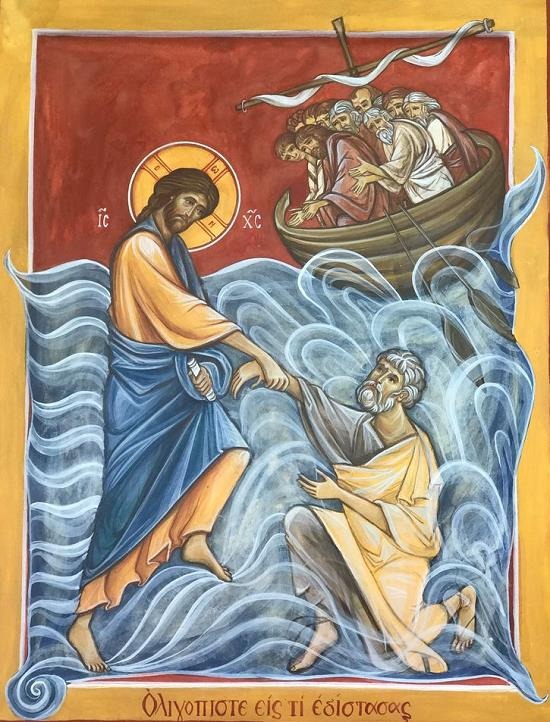
Look at the Gospel reading and set aside the popular images like Jesus walking across a swimming pool. What we see, instead, is the band of disciples fighting a squall on the Sea of Galilee all night long until nearly dawn. While they struggle in the boat, in the midst of the storm, Jesus stands there in impossible calmness. God is always a point of impossible calmness in the center of the tempest. Peter wants to join him, but that means stepping deeper into the tumult rather than escaping it. Jesus has but one word in response to Peter’s faltering courage: “Come.” The reward that Peter receives for his courage, and despite his faltering trust, is to be lifted up out of harm’s way. Peter isn’t penalized for his weakness. No, Jesus takes Peter exactly as he is and rewards the strength of his trust in him by stepping out of the security of the boat in the first place.
If we look for God’s loving presence only in the big, showy miracles we want, and sometimes demand of him, we will be disappointed. God exceeds our expectations, but in wholly unexpected ways. It’s up to us to look for God not so much in the results, but in the process. The Jewish nation in Paul’s day could not accept Jesus as the Messiah because he didn’t overthrow the Romans and restore the kingdom of Judah. On the contrary, the world as they knew it was utterly destroyed within that same generation, and yet, the Messiah was there. God is most often found where we least expect him and in the least obvious ways.
Once upon a time, Moses went up the mountain of God, and there encountered the burning bush, where God revealed to him his private, personal name—Yahweh, I AM WHO AM. Later, when God gave Israel the Law—the Torah—on that same mountain, the revelation came in whirlwind, earthquake, and fire. Many years later, the prophet Elijah, in desperate straits, climbed the same mountain in search of Yahweh, expecting to find him in wind, earthquake, and fire. But Yahweh was not in any of these. Instead, God manifested himself in what the Hebrew describes as a fine, silent voice—that barely perceptible, whispering voice that hides in the back of our minds while chaos rages around us.
Today’s readings are an invitation to put aside our expectations and demands that God fix everything that’s wrong and make everything right. Trust takes little courage when we think we have God at our beck and call to solve our problems. It’s a different story indeed to look for God in the still silence that hides in the chaos of the raging storm. Everything in us wants us to wait for deliverance and rescue. It takes courage to step out into the maelstrom of life. Yet our trust lies in that silent voice that beckons us and says to us, “Come. Do not be afraid. It is I.” Εγω ειμι (egō eimi). I AM. Yahweh.
Get articles from H. Les Brown delivered to your email inbox