
Flesh and Spirit and Life

Fifth Sunday of Lent Scripture Readings
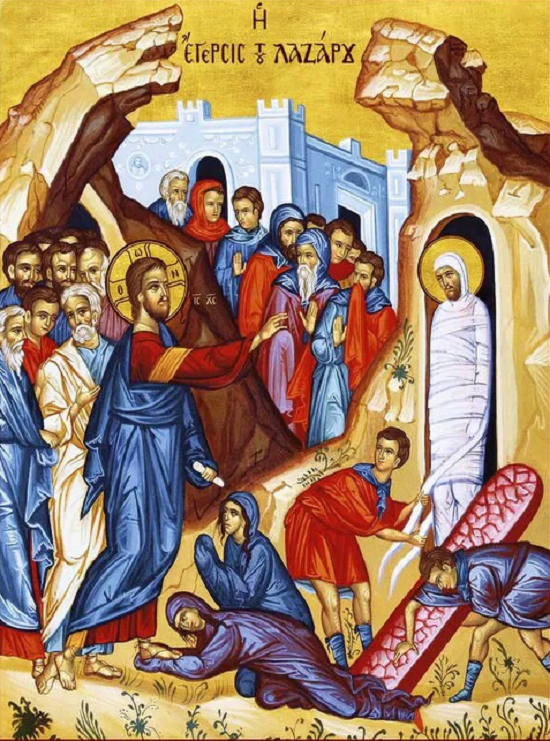
Although it’s very tempting to focus on the details of this remarkable story—a story that serves as the apex of John’s exposition of Jesus’s ministry—let’s not. Let’s take a step back from it so we can better see how this story not only fulfills the promise made in John’s prologue but also sets the stage for what is to come. Remember once again that John’s is the mystical gospel. It’s prophetic literature not because it foretells the future but because the past events it describes are present and happening now. What’s the promise? How does this story point toward its fulfillment?
The key to understanding what’s happening in today’s gospel, I believe, can be found in the second reading from Saint Paul’s letter to the Romans. Look at it. “Those who are in the flesh cannot please God. But you are not in the flesh, you are in the Spirit…” Paul contrasts two critical concepts here—concepts that have historically gone off the rails: flesh, in Greek (σαρξ, sarx), and spirit, in Greek (πνευμα, pneuma). Paul isn’t talking about body and soul. Those are concepts from Aristotelian philosophy, but Paul was speaking from a Semitic, Hebrew mentality. He’s not contrasting the physical with the spiritual, but he’s highlighting two life-orientations—what contemporary moral theologians call “fundamental options.”
The first life orientation, which he calls sarx (flesh), describes a life organized around self-sufficiency, self-will, and self-gratification. It is a life immersed in the pursuit of the unholy trinity: wealth, power, and prestige. It’s essentially inward-facing, locked in the concerns that are encompassed by our skin. The other orientation, which he calls pneuma (spirit) is exactly the opposite. It’s the orientation of the human person away from the self and outward toward the Other—both those others with whom we share the gifts of existence and life, and the Eternal Other from whom it all came and to whom it will all return. Paul suggests that even when the heart is beating, the blood is pumping, and the air is going in and out, those who live as though God doesn’t exist are dead.
It’s the pneuma, the spirit, as trust in God that gives life. In the first reading, Israel was destroyed. Its sarx, its flesh, was crushed and lifeless, without a possibility of rising again by its own power. Yet the Prophet Ezekiel comes on the scene and speaks the Word of the Lord to them, telling them that in the midst of their hopelessness, the power of God is trustworthy. In God’s kingdom, there is no ultimate catastrophe, there is nothing that cannot be overcome, there is no death. For Israel, pneuma, spirit, means trust in the Lord. “I have promised, and I will do it, says the Lord.”
Nowhere in the gospels before the resurrection do we see the contrast between sarx and pneuma more clearly than in today’s reading. Once again, we see the futility of the human condition laid out before us. As the woman at the well languished with thirst for meaning in her life and the man born blind’s life was crippled by his blindness, so today Lazarus is overwhelmed by sickness and death—the ultimate failure of the human condition, of sarx.
For the whole of Lent so far, we’ve faced the reality and the powerlessness of sarx, from Jesus’s temptation to trust in his own wisdom and power in the desert, through the glory of God manifest in his flesh at the Transfiguration, and down even now to the death of Lazarus. Each step of the way, we’re shown that sin isn’t what happens to us or necessarily what we do; it’s where we misplace our trust and reliance. We think of failed relationships and disabilities, sickness, and death as ultimate evils and the bane of human existence. They’re not. They’re part and parcel of our human condition. They’re the necessary cognates of sarx. They come with the territory.
From the midst of this reality, pneuma (spirit) arises. Spirit isn’t an external add-on to flesh. Pneuma emerges through the world of sarx, and the promise we find in the prologue of John’s gospel: καὶ ὁ λόγος σαρξ ἐγένετο καὶ ἐσκήνωσεν ἐν ὑμιν: “And the Word came into being as flesh and settled in our midst.” We see exactly that in the raising of Lazarus. The raising of Lazarus isn’t about Lazarus at all. Lazarus never speaks, and his return to life was only temporary. This gospel passage is all about Jesus, all about Mary and Martha, and all about us, the observers.
Evidently, Jesus had something important he wanted us to know about sarx and pneuma, about faith and trust, and about God’s relationship with us. He heard about Lazarus’s illness, yet he waited. The death of Lazarus wasn’t the greatest tragedy, after all. In fact, it was just a part of life as sarx. The greatest tragedy would have been to give up hope and cease trusting God. In the face of the impossible and of human despair, God comes.
Martha, facing the painful reality of life, complains, “You could have done something, but you didn’t intervene. Why?” She thought that Jesus was offering her the same old pious platitudes. “Well, at least he’s out of his suffering.” “He’s in a better place.” This was most definitely not the case. Instead, Jesus is forcing Martha’s belief to an entirely new level. He’s revealing the pneuma from within the sarx. “Εγω ἐιμι” (Ego eimi). I am the resurrection and the life. Yahweh. Jesus doesn’t promise resurrection or give resurrection. Instead, resurrection is a person. It’s not a what or a when. It’s a who. The Word, “Lazarus, come out!” came into being and settled in our midst. Spirit both acts through and transforms flesh.
A woman named Eleanor had been sober for eleven years when her son died of an overdose. At his funeral, her sponsor sat next to her. Afterward, in the parking lot, Eleanor said: “I could drink tonight and it would make complete sense.”
Her sponsor didn’t argue with her. Just said: “I know. Where are you going right now?”
Eleanor thought about it. “Probably a meeting.”
She went. She didn’t share. She just sat in the back and let other people’s voices fill the room. On the way out, a young woman — two weeks sober, visibly shaking — stopped her and said, “Do you think it gets better?”
Eleanor said, “I have no idea. But I’m here.”
She never drank. Not because she had answers, but because she kept turning toward the room instead of away from it. That’s Martha on the road. Grief in her hands, God in her direction.
God acts in and through the world and humankind for those who trust not in their own power and wisdom but in God. Through failure, disability, sickness, and even death, the brilliance and power of Spirit shines through and transforms sarx. Jesus’s constant trust in the Father and obedience to his will are what reveal the resurrection—life unconquerable.
It’s the raising of Lazarus to new life that convinces Jesus’s enemies that he must die. The power of those who trust in the spirit arouses fear and hatred among those who trust in the flesh. The life-giving power of God engenders the lust for death in those who trust only in themselves. Yet, as we shall see over the next few weeks, even the power of death cannot resist the power of life in and through our loving God.
Readings & Homily Video
Get articles from H. Les Brown delivered to your email inbox