Seeing and Believing

Easter Sunday Scripture Readings
In the eighteenth century, the Enlightenment turned the world on its head. Belief gave way to reason, and the scientific method of observation, questioning, proposing a hypothesis, experimenting, and analyzing took its place. That gave humankind a technological revolution, but it robbed us of something at least as important. It subjected faith to experiential verification, forcing the spirit to compete with the physical—while the conceptual tools of each are incompatible with the other. What I mean is that encounters and experiments belong to two distinct but interrelated universes.
Let’s talk about belief. The Enlightenment was right to challenge uncritical beliefs of the sort that infected humanity from the beginning. Humans are, and have always been, storytellers. It’s the means by which we understand ourselves and our place in the cosmos. In short, myth is the framework we use to find and share meaning. Meaning is not a question that science can answer. On the other hand, stories take on a life of their own, and when their context changes—a different time, a different culture—they can not only become divorced from their meaning but can be given interpretations antithetical to their original purpose.
Some examples of stories given interpretations far afield of what they were intended to convey include the creation stories in the Book of Genesis and the story of Adam and Eve in the garden. People down to our own day try to apply scientific thinking to these spiritually meaningful texts and succeed only in creating for themselves an unreal universe that has no meaning. They convey neither spiritual nor scientific truths, and rational people are right to challenge those beliefs. They go too far, however, when they challenge the myths themselves because science has no tools to handle spiritual meaning.
Why am I talking about this on Easter morning? Because the difference between belief and faith will determine our understanding of Easter. I use the two terms to mean very different things. Beliefs can be learned. They can be shared. They can be expressed. And, depending on context and understanding, they can be wrong. Faith is a very different animal. Faith exists in the realm of experience, in the realm of relationship, in the realm of trust. Faith can find expression in beliefs, and beliefs can bolster faith, but they are not synonymous.
We humans do things rather backward. We formulate systems of belief to lead us to faith. Yet faith is the key that unlocks the meaning behind our beliefs. The rationalists are not only right to criticize faithless beliefs, they do us a favor. Faith—that is, trust—must come first before understanding. Look at our gospel today. Mary Magdalene came to the tomb and found it open and empty. That’s all she knew. Her reaction was fear. Peter came to the tomb and rushed in. He saw the burial wrappings—the shroud and head cloth—folded carefully but empty. His reaction was confusion. The disciple whom Jesus loved hesitated. He approached with reverence. He saw what Peter had seen, but he saw things differently. He saw and believed, though the gospel says they did not yet understand the scripture that Jesus had to rise from the dead.
The disciple whom Jesus loved saw and believed. Was it the love that made the difference? Did his relationship with Jesus allow him to observe what the others had only seen? Was what he saw what we now call the Shroud of Turin? I have seen the Shroud of Turin up close and personal. I have seen, and I believe. If the Shroud is what the physical evidence suggests it may be, what the Beloved Disciple saw was not merely empty linens. He saw linens that bore the image of what had just happened—scorched from within, imprinted by light, still warm perhaps from the event that had passed through them moments before. He saw the first photograph of the resurrection, taken by the resurrection itself.
No wonder he believed. No wonder John says he didn’t yet understand—because what he was looking at had no category. It had never happened before. The disciples did not find an empty tomb and construct a resurrection theology. They found evidence of something that demanded a new category entirely. The resurrection is not a conclusion. It is an encounter with something unprecedented—something that leaves marks on linen and on people, and that no one who encounters it up close is ever quite the same afterward.
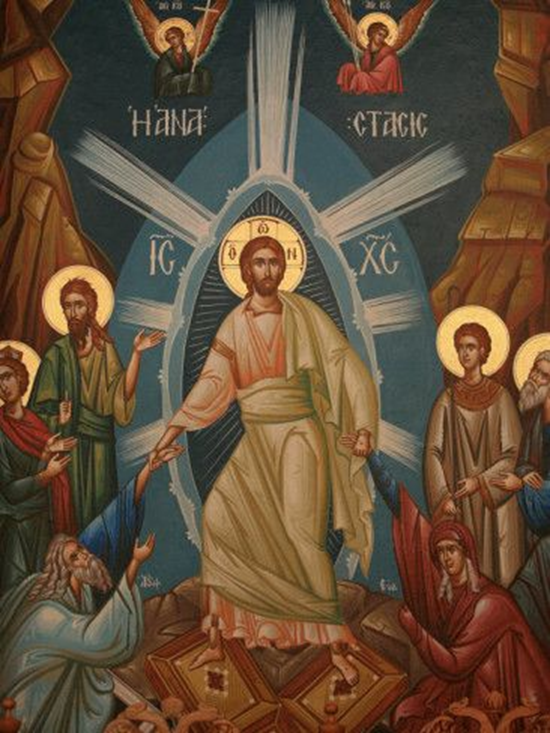
The physical mechanics of the resurrection are beyond our grasp. There is, nor can there be, any physical, experimental “proof” of the resurrection. Our experience of the resurrection begins with the testimony of those who were there. But that’s just the beginning. Our trust in their word—their stories—must lead us to a personal encounter. Like the people of the Samaritan village, we start out hearing their testimony and descend into faith. “We no longer believe because of your word; for we have experienced for ourselves, and we know that this truly is the savior of the world.” Like them, and like Jesus’s own disciples, we cannot seek understanding so that we might have faith. Rather, like Saint Augustine, we embrace fides quaerens intellectum—faith seeking understanding. We stand in the empty tomb this morning in the shadow of death. Will we, like the beloved disciple, see and believe? Christ is risen! Христос Воскрес! (Christos Voskres!)
Get articles from H. Les Brown delivered to your email inbox