Whose Sins You Shall Forgive

Second Sunday of Easter Scripture Readings
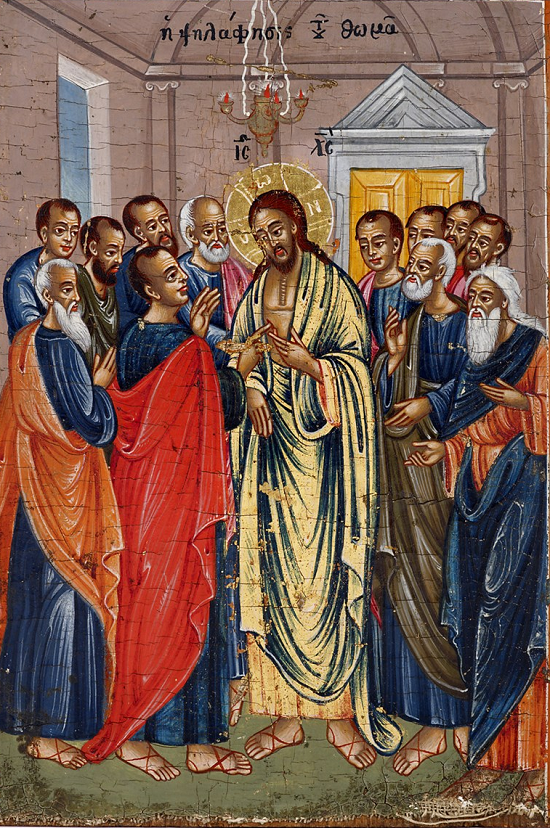
In preparing for today’s liturgy and homily, once again, as often happens, I discover that the common understanding of the gospel passage is not often the richest one or the best one. It happened once more with this one. Perhaps the usual focus on Thomas’s doubts and his transition to faith may not be the best approach. In fact, it may not be the thrust of today’s gospel at all. Whereas the usual focus on Thomas teaches that faith without proof is a higher accomplishment, how does that affect us who already believe? Remember that John’s mystical gospel implicates us. It’s not easy to find ourselves reflected in Thomas’s experience. If it’s not primarily about Thomas’s doubt and faith, what is the point?
Today’s gospel is about one thing: forgiveness. Does that surprise you? Look at where we are in the gospel. What you just heard was the original ending. It is the point toward which the whole gospel has climbed. It is the fulfillment of a promise Jesus made to his disciples: “I will ask the Father, and he will give you another Advocate to be with you always, the Spirit of truth which the world cannot accept, because it neither sees it nor knows it.” And again, “The Advocate, the Holy Spirit that the Father will send in my name—he will teach you and remind you of all that I told you. Peace, I leave with you; my peace I give you. Not as the world gives do I give it to you.” That fulfillment happens here in today’s gospel on the day of Resurrection. For John, this is Pentecost, and there is no other.
Pay attention to the details John presents us with this morning. It starts on the day of Resurrection, and yet Christ has already ascended to the glory of the Father. He breathes on them. It is the breath of the Spirit that wafted over the waters of chaos to create. Jesus, mirroring the Father, breathes his Spirit over the chaotic band of disciples: cowards, deniers, abandoners, renegades. If the creative Spirit of Genesis brought about the universe and its array, the Spirit of John brought about the community of the church. It creates something out of nothing. And that’s when we notice Jesus’s first words echoing in that upper room: Peace! Eιρηνη (eirene)! Shalom! This is the peace he promised that the world cannot give. The world seeks the end of conflict. The Spirit brings wholeness, healing, fullness of life, and communal well-being. The peace that comes from the Spirit creates new relationships out of old wounds.
We cannot understand how this is constitutive of forgiveness until we step away from the concept of sin as transgression. If we’re still counting sins as the number of times we did wrong, we’ll never fully appreciate what John was saying. Sin isn’t transgression. It isn’t wrongdoing. It’s a breakdown in relationships. Once we look around, seeing through that lens, we see our broken selves, our broken bonds, our broken world in a different light. It’s a world that’s not at peace with itself; it’s a world that desperately needs healing… needs the peace the world cannot give.
The disciples were gathered in that room in distrust. The doors were locked because they distrusted the Jewish authorities and their minions. They distrusted one another because they’d seen what each of them had done. They distrusted God because the one they’d dedicated their life to in God’s name had failed them. What they found in that room on that resurrection day was peace. The creative Spirit of peace and reconciliation. The Spirit of forgiveness. It has nothing to do with saying you’re sorry, but everything to do with healing the wounds of division. It has nothing to do with beating your breast or on your knees and crying, “O my God, I am heartily sorry…” and everything to do with letting it all go.
Don’t think that when Jesus said, “Whose sins you forgive are forgiven them, and whose sins you retain are retained,” that has to do with the other people. No. When you forgive others as an individual or as a community, you’re healing your side of a broken relationship and setting both of you free to heal. If you retain that brokenness, it remains yours as well as theirs. You see, just as injury is a two-way street, the perpetrator and the victim locked together in a painful dance, forgiveness works the same way. Healing can’t begin until at least one of them gives it up.
A man I’ll call David had a falling-out with his brother over their mother’s estate. Nothing dramatic — just the slow poison of a disputed piece of furniture, a perceived slight, a lawyer’s letter. They hadn’t spoken in three years. David came to me not for absolution but because he was exhausted. He said, “I’ve gone over it a thousand times and I’m still right.” I told him I believed him. Then I asked: “How’s that working for you?”
He laughed, which surprised him.
What he eventually understood — and it took months, not minutes — was that his being right had nothing to do with his being free. He was still locked in that room with his brother, doors bolted from the inside, replaying the same argument. The wound belonged to both of them equally, regardless of who caused it.
He reached out. His brother wasn’t ready. That’s the part nobody tells you — you can release your side of it and the other person may not move. But David did something the disciples did: he stopped waiting for the world to fix it and let the Spirit do what the world cannot. He said later, “I don’t know if my brother and I will ever be close again. But I’m not in that room anymore.”
Now, where does Thomas come into this picture? Thomas had difficulty accepting that healing after woundedness was possible, that life could overcome death, that what was broken could be restored. He showed up a week after Resurrection Day, not believing that their close-knit band could stay together, not believing that the Spirit of Jesus that had done such wonders could continue, that God would want anything more to do with him or his useless apostate companions. What did he find? He found the embryonic Church still intact. He found the spirit of doom and gloom had lifted. And, most importantly, he found the Spirit of Jesus alive and well in their midst, wounded but unbroken. He found that God was doing for them what they could not do for themselves.
That’s why there’s a sacrament of reconciliation. Not to count your sins before a judge, but to find your way back — back to the upper room, back to the community, back to the wholeness the Spirit is always already creating. You walk in carrying your side of whatever is broken. The absolution isn’t the priest saying you’re off the hook. It’s the Church saying: “The Spirit that breathed over chaos and made something new is breathing here too. You don’t have to stay locked in that room.” Thomas didn’t find a courtroom when he came back. He found the wounded, risen Christ still present, still offering peace. That’s what you find at the door to the upper room. That’s what you find when you walk through it.
Get articles from H. Les Brown delivered to your email inbox