Entropy and God’s Spirit

Solemnity of Pentecost Scripture Readings
You may have heard it said that spacetime is expanding. In practice, that means everything is moving apart and that the movement is accelerating. It’s entropy on a cosmic scale, that is, the tendency of things to fall apart over time. Death is the perfect example of entropy… what once was together has now come apart. Death is far more than the cessation of movement. It is the victory of decay over growth. Although the spirit isn’t subject to death—the spirit is life—it’s still subject to decay and dissolution. We call this spiritual decay and dissolution sin. Sin on the spiritual plane is the cognate of death on the physical.
There are so many ways that we can talk about entropy. It’s not a force at all—a power that pulls everything apart. In fact, apart seems to be the natural condition of things. Take away everything that holds the universe together, and it all dissolves. If the Big Bang actually happened the way cosmologists describe it using the language of mathematics, then, rather than the birth of the universe, the Big Bang should be seen as the death throes of the singularity, that indescribable starting point of it all. Physics and mathematics are the ways we use to describe what we humans have observed and measured. The disciples and evangelists had no such conceptual framework in which to organize and comprehend their experiences. They used, instead, the methodology humans have employed since the beginning: storytelling. They couldn’t have described what happened to Jesus and to themselves using the framework of science and technology—even if they had wanted to—and if we try to understand them within that modern framework, we also will fail.
It is very difficult to translate one world of meaning into another. There’s never a one-to-one correspondence of concepts from one world to another, so translation is always an interpretation. These homilies of mine are my attempt to make that translation from the world of the Scriptures and their stories to our world of scientific facts. My interpretations attempt to bring us as close as possible to the disciples’ experience of Jesus’s death and resurrection, and to what meaning these earliest Christians found in it. What I think they found was the reversal of entropy. That reversal was intimately bound up with life—the principle of self-organization that permeates the universe. Our Scriptures talk about it in terms of spirit-breath: πνευμα (pneuma) in Greek, רוּחַ (ruaḥ) in Hebrew. For the ancients, spirit and breath were not two things but one: the manifestation of life.
So, we have the Spirit of God breathing into the waters of chaos and bringing all things into existence—bringing our chaos into organization and bringing about the reversal of entropy. And it all moved inexorably to a single end: the emergence of conscious life. Everything else it described was prelude. Then the prophets spoke of God’s Spirit—God’s Breath—bringing life to human death, both physical and spiritual. For them, Spirit wasn’t just about life’s creation but its restoration. And finally, at last, we have the physical resurrection and transformation of Jesus the Messiah, putting an end to sin and death, conquering them both, and overcoming the dissolution and decay of entropy.
Today we remember and celebrate the moment when Jesus passed on to us his experience of stepping outside the world of dissolution and into the living breath of God. All the images that these early Christians used in telling the story convey the same message: what once was falling apart, God has put back together and brought to life. Jesus spoke of peace… not our kind of peace, but shalom-peace, wholeness peace, a wholeness that put to rest the fear of dissolution — the fear that kept the Apostles locked away, the fear that keeps us in pursuit of wealth, power, and prestige to ward off the threat of loss.
He breathed into them that Spirit of God that nothing could ever take away or take apart: Life unconquerable, life inviolable. Not just the breath of God that once breathed life out of chaos, but the very same breath still creating life out of the chaos of our existence today—not another breath, but the same one now as then. And with that breath, what commission did Jesus give to his Apostles? The commission of reconciliation—the commission of healing the wounds of sin and death, not only in the Apostles themselves, but into the world. For those whose inner chaos and entropy and fragmentation have been healed by the life-breath of the Creator himself through the ministry of the Redeemer, to be complete, their reconciliation must include others—all others.
There it is: the essence of the Pentecost we celebrate today. We’ve been healed—a body of many members transformed physically and spiritually into a living whole. But we’re not whole until we bring that wholeness, that reconciliation, that unity out of diversity, into our world. What our culture has tried to name with the imperfect phrase “diversity, equity, and inclusion” is in fact what the Church has always called the work of the Holy Spirit. We’ve been doing this for two thousand years. We were doing it at Pentecost. It is the healing of sin and division, a resurrected life from the death of dissolution and isolation; it is our anamnesis, the rekindling of the fire of God’s life-giving love here and now.
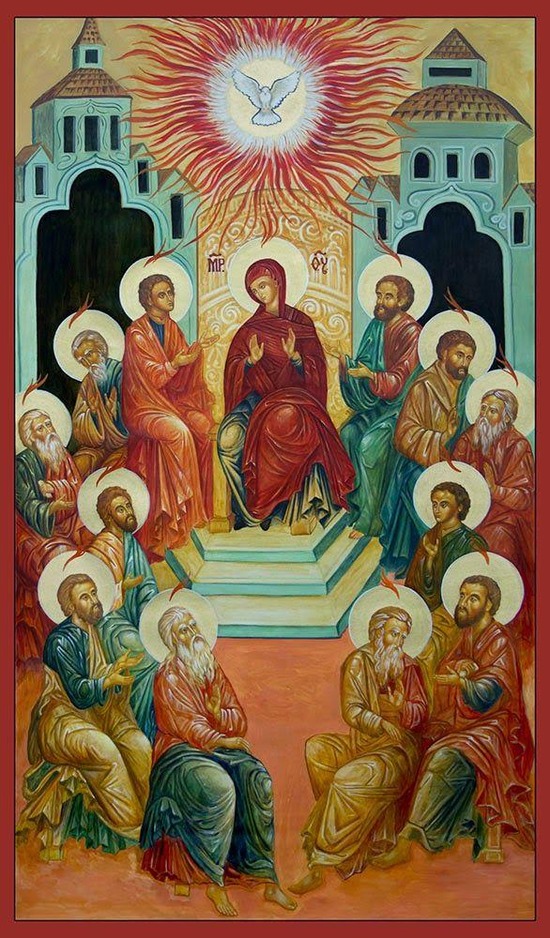
That’s why, my friends, Pentecost was described as tongues of flame over each of the disciples—one fire burning in many hearts. That’s why each of the listeners heard the good news in their own language—the Tower of Babel reversed and overcome—one message, one love, in an infinite variety of vessels and means of understanding. Come, Holy Spirit, and fill the hearts of your faithful, and enkindle in us the fire of your love. Send forth your Spirit, and we will be recreated, and you will renew the face of the earth.
Get articles from H. Les Brown delivered to your email inbox