The Trinity and You

Solemnity of the Most Holy Trinity Scripture Readings
Some people have questioned why I insist on taking the position that God doesn’t send anyone to hell. To me, this is a demonstrable theological fact, and today’s liturgy and its readings strongly back me up, from beginning to end. Indeed, condemnation and punishment are contrary to everything that has ever been revealed to us about the nature of our God.
Let’s start with today’s gospel reading. In it, Jesus, whom John himself identifies as the Word of God made flesh, answers a deep theological question that Nicodemus posed to him. Jesus tells him that no one can see the kingdom of God unless he is “born ἄνωθεν (anōthen).” That word is a clever pun. It literally means “from above.” It carries with it the sense of origin in both place and time: both from the source and from the beginning. Nicodemus asks, how can someone be born from the beginning? Can they go back into their mother’s womb? But Jesus chooses the other meaning—to go back to the divine source. Today’s gospel is part of Jesus’s explanation because going back to the source means returning to the God who created it all.
And there we have it… God’s motivation for being the source of all-that-is: “God so loved the world…” This is the Greek word, αγαπη (agapē), which is neither emotional love nor friendship love, but the self-giving love that acts for the good of the beloved regardless of their merit, worthiness, or deservedness. Agape is pure love for the sake of the beloved. God created because that’s just who God is. And not only that. God sent his unique Son—his unique image and reflection—into the world. He sent the Son so that all who live could see who God is and how radical his love is. And the love of God translates in terms of life. The dichotomy of existence is presented to the world in stark and inescapable option: live or perish. It’s a choice as love is a choice, with dire consequences.
Jesus says that the Son—the living, loving perfect image of the Father—came into the world not with condemnation but with a way out of the threat of annihilation. The next three sentences tell the whole story, from the creation until now. “Whoever [encounters the Son, the image of the Father and] believes in him will not be condemned.” “Being condemned” does not mean being punished. It means only to be stuck in a condition of lifelessness. And the way out is put right there in front of us: to believe in that Son who reflects the love of the Father perfectly. Here, “believe” is not an intellectual assent. This belief has no content other than the one believed in. It’s saying, “I believe in you.” It’s accepting and returning the love and trust given to us by the Father in calling us into existence. Believing in the Son is simply trusting, with all our being, that God is as he has shown himself to be, and relying on God rather than on ourselves.
Yet Jesus says, “… whoever does not believe has already been condemned…” What does it mean, after all, not to trust in God? Isn’t it a throwback to our own pathetic devices? Isn’t it living a life of futility, frustration, and self-imposed misery when we try to trust wealth, power, and prestige to pull ourselves up by the bootstraps? Isn’t it the state of condemnation to futility that we see playing out all around us these days? Is that living life to the full, or is it a slow way to perish? The futility—the condemnation—is the default state we exist in when we have no trust in anything outside ourselves. It’s not something God imposes on us. Rather, it’s what’s there when God isn’t.
And Jesus says we find ourselves existing as those condemned only when we have “not believed in the name of the only Son of God.” When we find ourselves sinking into the cesspool of our own making—the cesspool of greed, falsehood, manipulation, exploitation, cruelty, and shame—the only way out is to trust the hand that’s reached out to us. That’s what it means to trust in the only image of the Father, God’s image alive in this world.
What does it mean to trust in the name of God’s only Son? In the first reading, we encounter God’s name. Throughout their history, the Hebrew people have referred to God as the Name. And here is that revelation: “Yahweh, Yahweh, a merciful and gracious God, slow to anger and rich in enduring love.” God’s entire Name, his entire self-revelation, consists in love. “Merciful” in Hebrew refers to the protective kindness a mother has for the child she carries in her womb. “Gracious” refers to the generosity of God’s love that can’t be earned or won and is not deserved. “Slow to anger” is God’s patience with his weak and wayward creation, which cannot lose that love, regardless of our neglect or misdeeds. “Rich in enduring love” means literally the unwavering consistency of a mother’s commitment to her child regardless of age and regardless of their successes or failures. This is true agape love. And that, friends, is who our God is and who the Son has revealed him to be, not only in words but in his total trust that the love of God would carry him through death safely into undying life.
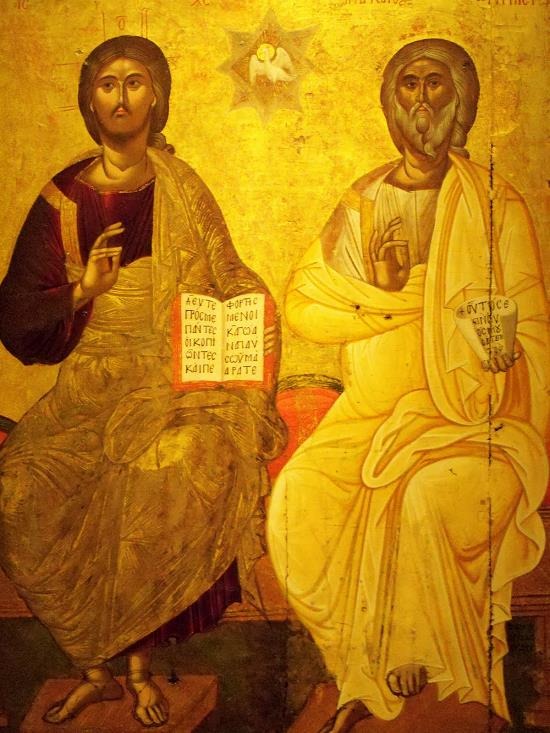
And now we come to the deepest reason God cannot be punitive—because the love that God is, at the Name’s heart, is the love that the Trinity lives, eternally, in itself. This is not a logical argument based on theological definitions, but an experiential one. We don’t assent to the Trinity; we trust God, Father, Son, and Spirit. Jesus is the touchstone of this experiential trust. In the teaching, the death and resurrection of Jesus, the disciples experienced the love of the Father for the Son and the Son for the Father. John calls Jesus the Word of God—that Word that the Father spoke, and that Word was God himself. The Father, the speaker, spoke himself, the Son. The speaker, the spoken, and the Word that contains them both, that’s one difference between God’s Word and ours. Ours is about ourselves, God’s is himself.
The other difference is that it is the speaking itself, which is the unity, the love which embodies the Father in the Son. The Spirit is that love speaking itself eternally. When we hear the Word—not with our ears but with our minds and hearts and strength—that speaking is in us and we are in it. The Speaker, the Spoken, and the Speaking are all one and the same, and we are the recipients. This isn’t passive, but a call to action. As the love of God, expressed in the Son and alive in us through the Spirit, brings us to life, we are empowered to continue the work of the Father in the Son through the power of the Spirit as we extend the Word—the living love of the Father—to those who most need to hear and experience it. As they see our trust in the Trinity alive in us through our reflection of God’s love, they may be inspired to trust as the Son trusts the Father and we trust the Son through the power of the Spirit.
The Trinity is not a theological construct. Instead, it is the grace of our Lord Jesus Christ, echoing the love of God the Father, drawing us into the communion of the Holy Spirit, the Spirit of love and unending life.
Get articles from H. Les Brown delivered to your email inbox