Eucharist as Trust

Eighteenth Sunday in Ordinary Time Scripture Readings
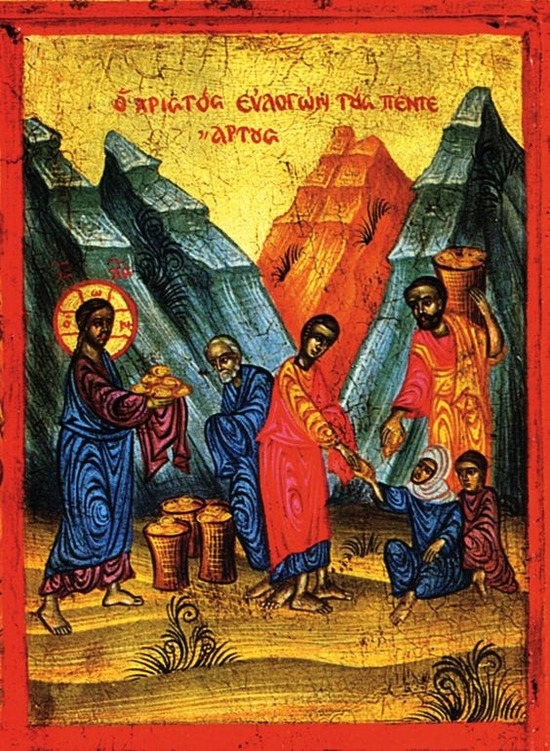
For once, all the readings in today’s liturgy line up perfectly to provide us with one critical understanding, and it’s not one that we generally see very clearly. Whether it’s evident to you or not, all of today’s readings are eucharistic. They draw our attention inexorably toward those four critical eucharistic words in today’s gospel: took, blessed, broke, gave. Jesus took the five loaves and two fish, said the blessing, broke the loaves, and gave them to the disciples. With those words, Matthew wanted us to see and to understand eucharist. There are so very many ways to interpret eucharist. There’s the obvious understanding of eucharist as giving thanks because, after all, the Greek word ευχαριστια (eucharistia) means thanksgiving, and that aspect—the saying the blessing—is constitutive of it. But eucharist exists at the core of a world of meanings that we come to understand in a variety of contexts: gift, communion, sacrifice, nourishment, life, hope, eternity, heaven, sacrament, promise, presence, love.
Today’s readings highlight another critical aspect of eucharist that I don’t think we very often hear about or consider. What we see presented before us here is eucharist as trust. We’ve been told that eucharist requires faith, but too often we interpret that to mean belief that Jesus is present in the Holy Eucharist, body and blood, soul and divinity. That kind of faith is little more than intellectual assent to a series of propositions. That understanding of eucharist demands little—too little—from us. We don’t have to put our lives on the line for that kind of faith. Today’s readings invite us to go much deeper into eucharist and to trust… to let go and let God.
Look now at the gospel reading. It’s possible that John the Baptist and Jesus may have grown up together. His mother was Mary’s cousin. Perhaps they even studied together at the Qumran community by the Dead Sea. At least, they shared a deep spiritual commitment and bond. Jesus chose to let John inaugurate his mission when he presented himself to John at the Jordan. So, when Jesus learned his lifelong companion and soul mate had been killed, he needed to get away. Why? Why do we seek solitude when we feel overwhelmed? We feel like we’re empty and we’ve nothing more to give. Yet, when Jesus got to the deserted place, he found the crowd of needy people there waiting for him. Empty as he must have felt, his response to them was to give them his attention, to minister to them, and even to heal their illnesses. His response to them was eucharist.
Like Jesus, the disciples, too, saw a need. It was getting late, and the crowd must have been getting hungry. Unlike Jesus, when they saw the people’s need, they wanted to send them away to take care of themselves or to become someone else’s problem. But Jesus wouldn’t let them off the hook. His demand that they take on the responsibility threw them into a panic, forcing them to confront their own poverty. As he himself had refused to use his emotional emptiness as an excuse not to address the crowd’s needs, he asked no less of his disciples. “Give them some food yourselves.” That’s when eucharist happened—those critical four words. Jesus took, not their abundance but their poverty. He blessed what was there, not complained about what wasn’t. He broke the bread, dividing the little that they had so that as many as possible could be helped, and gave to his disciples to distribute to those in greater need. That is eucharist as trust: providing for others out of the little we have, trusting in God that it will be enough.
What was the upshot? “They all ate and were satisfied.” The Greek term χορτάζω (chortazo) means to graze to contentment. We translate it well as to become satisfied, which comes from the Latin satis, meaning ‘enough.’ Eucharist in this context means giving to others, not out of our abundance, but out of our poverty, in full trust that God, in his love for us, will make it enough. Eucharist depends not on our abundance or poverty, but on our trust that it is God’s abundant love that will make it enough.
Now look back at our other readings to see eucharist in action. Isaiah promises satisfaction of his people’s needs, not from wealth or abundance, but based on the reliance on God’s covenant of love—that enduring, nourishing mother’s love that the Hebrew Scriptures call חֶסֶד (ḥesed). What is eucharist but trust in that very covenant promise of love?
Likewise, Paul counsels his readers not to be distracted and dismayed by the appearances of weakness, emptiness, and poverty before the challenges of life. Our ability to conquer our challenges and provide satisfaction and sufficiency to ourselves and our world doesn’t come from our wealth, power, or prestige, but from our trust in the boundless love of the Father that comes to us, as it comes to the hungry people in that deserted place, in Christ Jesus.
Eucharist is our antidote to the discouragement and despair that we feel as we see the overwhelming need that surrounds us. Much as we may not like to hear it, the political, economic, social, and technological challenges we face aren’t unique. Humanity has been facing them in one guise or another from the beginning. Yes, we face disaster and destruction. But hasn’t it always been this way? There’s really no such thing as more or less devastation or more or less helplessness. Huge or tiny, need is need. If we believe Jesus, if we are children of the Gospel—the Good News—we will come to understand that satisfaction is found solely in eucharist as we in Jesus’s name take from our poverty and weakness, give thanks for however much we have, break it open, trusting that it will be enough, and give it to those who need it most—our time, our care and concern, our love. It’s our eucharist, our trust in God’s love that, however much or little it may be, it will be enough.
Get articles from H. Les Brown delivered to your email inbox