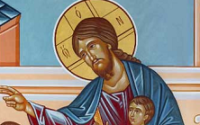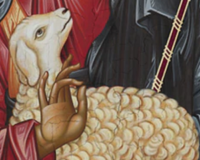
Fourth Sunday of Easter Scripture Readings Good Shepherd Sunday evokes images of a smiling Jesus hugging kids and petting lambs. Yet what we have here in this morning’s gospel reading is actually an indictment of the civil and religious authorities. He accuses them of preying on the very people they were commissioned to preserve and protect. It’s hard to see through the imagery that Jesus uses without an awareness of the passage’s context. Jesus had just cured a man born blind who had been called in and interrogated by the religious authorities. That led to the man’s being expelled from the temple. In response, Jesus accused the authorities of being incurably blind. The Pharisees reacted with indignation, asking Jesus, “You’re not saying that we’re blind, too, are you?” This gospel passage is Jesus’s reply. What Jesus is confronting here is something we now call “power distance.” It’s what he saw at work in the treatment of those entrusted to their care by those in positions of authority. If we look at Jesus’s example—that of the shepherd and the sheep—through the lens of our own cultural biases and see in the shepherd a herder whose only concern is getting the sheep safely to market, we’re missing the point entirely. The Good Shepherd’s connection to the sheep is relational, not transactional. That’s what makes all the difference. Think about that for a moment. For Jesus, shepherding wasn’t just a job, and the sheep weren’t just ciphers in a ledger—income and expense. The difference between shepherd and sheep wasn’t one of dominance and dependence, but of interdependence. It was a difference of role, not power and prestige. There was no “power distance.” No “us and them,” but only “us.” What did Jesus mean by calling himself the sheep gate and that all who came before him were “thieves and marauders”? Thieves are unwilling to pay the price. They come to the sheepfold only to get what they can from them, to bleed them dry, giving nothing of themselves in return. And what about the marauders? They not only want to take advantage of the sheep, but they also get a perverse, sadistic satisfaction out of seeing them suffer. It somehow builds their sense of power and prestige to show how much damage they can inflict on others weaker than themselves. How does that relate to Jesus as the sheep gate? The shepherd lays himself down into the gap in the wall, making himself the access point for the sheep to both safety and sustenance. Once again, the thieves and marauders are in a transactional relationship with the sheep, whereas Jesus presents himself as the doorway to a deeper relationship with them. Let’s consider this for a moment from the perspective of the sheep. When their relationship to those charged with their guidance, care, and protection is transactional, how does that make them feel? When authorities treat them as dependent, less than, inferior, and unworthy, what happens to them? The best that could result would be feelings of incompetence and worthlessness. The worst could be resentment, anger, rage, and violence. Whenever an artificial power distance is imposed, it results in an us-versus-them situation where the “us” side feels unjustifiably superior, and the “them” side feels angry and resentful at what is, in fact, injustice. The “thieves and marauders” syndrome arises wherever there’s need. “Even though I walk through the dark valley, I fear no evil.” The psalmist doesn’t say “if.” He implies the truth: it’s “when.” Every one of us, from time to time, has to wander lost in those deep caverns with insurmountable walls to either side, where no sunshine reaches, and the way ahead is unclear. Every one of us has had the experience of the sheep, needing the guidance, protection, and sustenance of the shepherd. The temptation that comes strikes those who find themselves in the role of shepherds. When we’re called upon to provide that guidance, protection, and sustenance, it’s way too easy to think of ourselves as privileged and those we can serve as underprivileged or even unworthy, and to demand that they prove themselves worthy of our help. Help becomes transactional. Our Christian community has dropped this gospel reading right in the middle of our liturgical celebration of the Easter season. There’s a reason for that, and it sits in the middle of the reading where Jesus proclaims, “I am the gate for the sheep.” Εγο ειμι (ego eimi)… I AM… Yahweh. It’s our God himself who manifests his care for us in the shepherd who makes himself the gate of access and protection for the sheep, who guides and sacrifices himself for their well-being. Who cares not a bit about the worthiness of the sheep but lives the relationship with them regardless of the dimensions of their dark valleys—the sick, the vulnerable, migrants and refugees without home or people, the hungry, the homeless, uncared for children, the poor and destitute, the unemployed, the mentally challenged, and those who don’t look, talk, believe, or act like us. We can’t look to Jesus two thousand years ago, who said Εγο ειμι (ego eimi), I am. We are the Body of Christ. He is not the gate for the sheep if we aren’t. We’re not being asked to change this country or the world or to fix everyone’s problems. We are called, however, to look with Christ’s eyes on what’s happening around us and to experience once again that metanoia, that change of mind and heart. We’re called to feel that same cut to the heart, that same compunction that caused the people in today’s first reading to cry out, “What are we to do?” Only if we’re willing to lay ourselves down in the gap in the wall as Jesus did will we find the answer to that question. Readings & Homily Video Get articles from H. Les Brown delivered to your email inbox