Tell Me Who You Are

First Sunday of Lent Scripture Readings
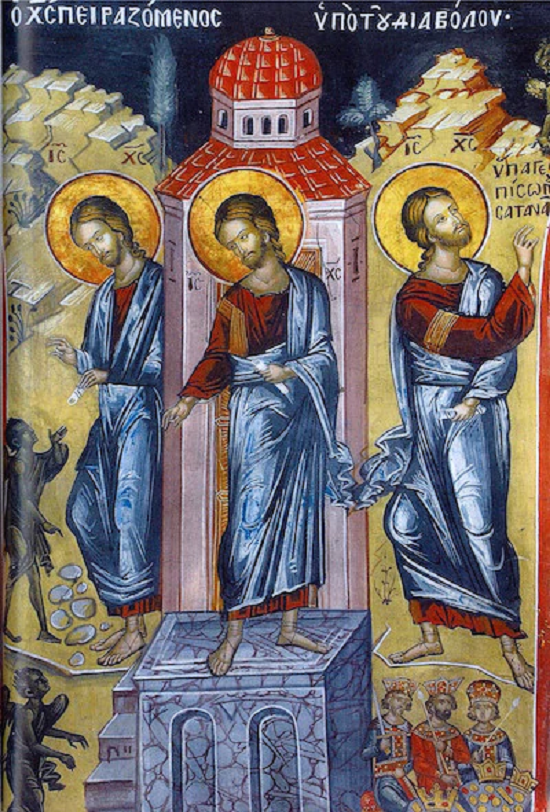
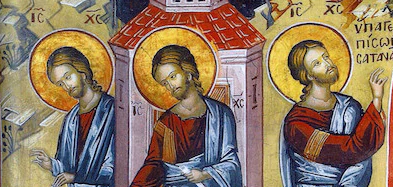
“When people tell you who they are, believe them.” The theme for today’s liturgy, as we pass fully into the season of Lent, is identity. As the caterpillar in Alice in Wonderland challenged her, saying, “Who are you?” today’s liturgy asks the same question. As always, the gospel reading provides us with the context. We’ve been on the mountain with Jesus for a number of weeks. We’ve been taken deeply into our identity as Christians through the Sermon on the Mount, but now we follow Jesus off the mountain and into the desert wilderness. In context, Jesus has just been baptized by John. His identity has been exposed publicly for all to see who have the eyes of faith, and immediately Jesus is led out into the wilderness by the Spirit to be “tempted by the devil.”
Pay attention. The words matter. Jesus is led. He’s not driven, not forced, but drawn to the deserted place to be alone with himself. He’s led by the Spirit. It’s not Satan, not the devil, not some demon or evil spirit, but the Spirit of God, the Holy Spirit. He is led out to be “tempted.” The Greek word for tempted is πειρασθηναι (peirasthenai). The better translation of that word is “to be tested.” That is, tested and refined like gold in a furnace. It’s not so much a sense of desire but of challenge. Jesus is led out to be tested by the devil—ὁ διαβολος (ho diabolos)—the one who tears things apart, divides, accuses, and tests. Jesus’s baptism and willing acceptance of his mission to the world as the Son of God opens him to have his mission and identity challenged and tested. As always, what today’s Scriptures tell us is that this is not about Jesus alone, but it concerns all of us and, in fact, all of humanity. Set aside your image of Jesus in this or any particular place and time and see the big picture. In this story, there are at least six contexts interwoven into our liturgy.
The first context is found in our first reading. God breathed into Adam’s nostrils the breath of life. Could there be a more intimate description of God’s gift of the רוּחַ (ruacḩ), the Spirit to humankind? Yet what is the serpent’s promise? “You will be like gods, knowing good and evil.” That’s a Semitic way of expressing having power over everything, exercising total moral authority. The test is, will you trust who God says you are and who you are meant to be, or will you try to define yourself on your own terms? Humankind failed the trial continually by trying to make itself into something it’s not, and what it discovered from the beginning until now is that was never what it pretended to be. It was naked and afraid.
The second context for the temptation story is that of God’s people, Israel, wandering in the desert for forty years. Three times, Israel faced dire challenges that threatened its existence, and three times it failed the test and would rather sacrifice its values and identity than trust in the God who called and supported them. They were hungry and threatened to give up, so God sent them manna as food. Then, at Massah in the desert, they found their lives too challenging and threatened to turn away from God unless he proved his presence. They were given what they demanded, but at the cost of their identity. And, finally, when Moses was on the mountain, they thought they’d been left to their own devices and turned to the golden calf, a god of their own devising. Three trials, three failures.
The third context is found in our gospel itself, where we find Jesus facing the same test as Adam in Genesis and Israel in Exodus. Becoming who you are and who you are meant to be is never easy. The spirit leads you out to where it’s just you and God, with no distractions or human help to get you by. Thus it was with Adam, thus it was with Israel, thus it was with Jesus. And Jesus faced the same temptation to write his own story as Adam did and to bitch and moan and give up as Israel did. Jesus, like them, faced the test of the unholy trinity: the bread of wealth, the salvation of power, and the idolatry of prestige. The devil doesn’t doubt Jesus’s identity; he plays on it: “Since you are the Son of God…” Yet in every case throughout his ministry and even up to his last temptation, “If you are the Son of God, come down from that cross, and we will believe in you,” Jesus refused to betray himself, refused to compromise his faith and integrity, and did what up until then humanity had failed to do.
It’s not by accident that Jesus’s temptation in the desert followed immediately after his baptism. Jesus is, after all, the paradigm of the Church as it lives out its identity as the Body of Christ. What Christ lives in commitment, mission, challenges, and testing, suffering and catastrophe, so the Church must face the same trials and the same temptations to sacrifice its identity and fidelity to the Father for the false promises of wealth, power, and prestige. We know how, over the centuries, the Church has failed to live up to these challenges. The Christian Church is the fourth context where the temptations in the desert live themselves out.
As the Church, so the Christian, you and I. There will always be that moment when we face certain disaster and find at hand the shortcuts around it, the same wealth, power, and prestige. The return on investment seems so worthwhile. We have the tools of the unholy trinity at our command to avoid the pain and achieve our ends, and the cost is so small: our integrity, our fidelity, our identity. And our eyes will be opened, and we will be like gods, knowing good and evil. That is our context.
There’s yet one final context that we see playing out all around us. What happens when society fails the test and yields to the easy way out of wealth, power, and prestige? Look at our own political reality and that of every nation that has succumbed. We’ve not only lost our way and lost our standing, we’ve lost our identity for the promise of becoming “great” again.
And you thought today’s liturgy was about Jesus and the devil in the desert two thousand years ago. You thought it was about Adam and Jesus. And here, all along it was about you and me and our relationship with God our Father and our call to fidelity and integrity. As Jesus’s fidelity through the challenges of his mission and suffering revealed the resurrection to us, so Paul saw how much more the hidden promise outstripped those challenges and their cost. He wrote, “How much more will those who receive the abundance of grace and of the gift of justification come to reign in life through the one Jesus Christ?”
Get articles from H. Les Brown delivered to your email inbox