
Breaking Out

Ascension Scripture Readings
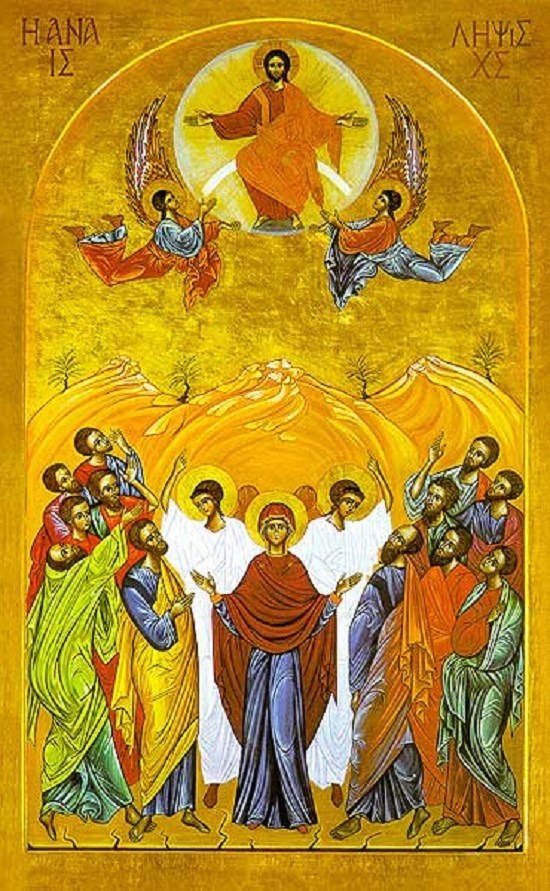
To appreciate fully the lessons that our Scripture readings are teaching us today, we have to break out of the physical limitations of our imaginations. The divine elevator is broken… it doesn’t go up there anymore. Well… in fact it never did. Look at the description of the event we call the Ascension in today’s first reading from the Acts of the Apostles. If we are able to look behind the superficial physical description we find there, we can discover the key that unlocks the spiritual dimension of these texts. Religious history has been no help in this, because it tends to stop at and become distracted by the physical imagery. What is this key? It can be found in the description of what happened to Jesus: “he was lifted up and a cloud took him from their sight.” It’s the cloud that tells us what this event really means.
The cloud is not weather; it is the Shekhinah, the Glory-cloud of the Hebrew Scriptures. It is the cloud that filled the Meeting Tent. It is the cloud that led Israel through the wilderness. It is the cloud that descended on Mount Sinai. It is the cloud that filled Solomon’s temple. It’s also the cloud that overshadowed Mary at the Annunciation, and that overshadowed the Mount of Transfiguration. It is the cloud that signals the divine Presence of Yahweh, the God and Father of Our Lord Jesus Christ. The cloud that takes Jesus is the divine glory receiving him into itself. As we come to appreciate the meaning of the cloud, we necessarily have to reevaluate what it means for Jesus to have been taken up. Obviously, it’s not our ascent into the air. Christ does not go up vertically, but up into. He is taken up into the inner life of the Father, into the throne-room of cosmic authority, into the in-and-through-and-over of all reality. “Through him, with him, in him, in the unity of the Holy Spirit, all glory and honor is yours, Almighty Father, for ever and ever, Amen.”
The point is this: Jesus broke free of the limitations that have always defined humanity. He broke free from the Law of Moses, he broke free from the chains of suffering and death, and at this moment of remembrance — this anamnesis — he breaks free even from the limitations of space and time. “Christ yesterday and today, the beginning and the end, alpha and omega. All time belongs to him and all the ages. To him be glory and power through every age for ever. Amen.”
This ascension, this transition beyond the limits of the physical universe, this transformation into the glory of the manifestation of the Father is the fulfillment of the promise Jesus made to his disciples when he said, “I will not leave you orphans,” as we heard in last Sunday’s gospel. How else could he ever have shown us the Father separated from him by an incalculable distance of space and time? How else could he have reached back through time to when and where it all began to manifest God’s saving love? How else could he have pledged to us that he would be with us—yes us: you and me—until the fulfillment of time—our time?
How is it possible? How can he do it? How does he do it? It is in and through us. It’s to us that he says, “Go therefore, and make disciples of all nations.” How are we to do that? How are we to live so that whoever sees us sees the Father? It is through living our baptism—living our union day by day with the suffering, death, and resurrection of Christ—loving as deeply and fully as he loved—that we can, as he did, draw all people to ourselves. We don’t make disciples by going after them. Jesus only called twelve. The rest of his followers—his disciples left what they were doing and followed him because there was something inside that drew them to Jesus. How do we make disciples of all nations? The same way Jesus did: by loving them indiscriminately and unreservedly, by caring for them without question, and by giving up his life for them, deserving or not. That’s how we live our baptism and draw others to share in that same act of love, that same death and resurrection.
If we share in Christ’s death and resurrection, if we share in his life-giving and life-affirming love, then we share in his ascension into glory, not the glory of wealth, power, and prestige, but the glory of the Shekhinah, the glory of the Presence. Like Jesus, we find ourselves broken out of the limitations that want to bind and define us.
Last century, the psychologist Kohlberg described moral growth as a long ascent through stages — a kind of breaking free that every human being undertakes, or fails to undertake, over the course of a life. We all start in the same place. A small child knows only one moral rule: seek what feels good, avoid what hurts. That is where moral life begins, and for some it never goes further. Most of us, eventually, climb to the next level — we learn that the world rewards us when we follow its rules, when we are good citizens, when we don’t make trouble. This is the conventional morality of most adult life, and it is not nothing. But it has a ceiling. The good citizen still lives inside a cage made of social expectations.
There is a further ascent. Some people break free of the cage and begin to act not because the law tells them to, but because they have come to see what is genuinely right beyond the law — protecting the vulnerable, telling the truth at cost, refusing the corrupt order. This is rare and it is precious. But even this is not the top of the climb. The final stage — the one Kohlberg himself called the most elusive — is when a person acts from spiritual principle alone, when the external scaffolding falls away and the soul is simply free to love. Not only does that stage transcend all the others, it breaks free from all the limitations put on a person by external or internal forces. And here is the secret: Kohlberg’s highest stage is not reachable by human effort. It is what happens when a person is taken up into the inner life of the Father. It is, exactly, ascension. Not the divine elevator going up. The soul being received, as Christ was received, into the Glory-cloud that always rests above and within everything that is truly free.
The cross of Christ wasn’t for Jesus alone. It is ours as well. The resurrection of Christ wasn’t for Jesus alone. As members of his body, we live the resurrection now. So also the ascension wasn’t for Christ alone. It is also for us, as the Father is in him and he in us and we in him. In this moment, this day, he who sees us sees the Father as we break through our own internal and external limitations as he did and live a life beyond our imaginings, doing the acts of love that he did and far greater. We do not live, love, or act alone. It is Christ and the grace that we inherited from him that moves us with the surpassing greatness of his power. For behold, he is with us always—ascended and glorious—until the fulfillment of days.
Get articles from H. Les Brown delivered to your email inbox